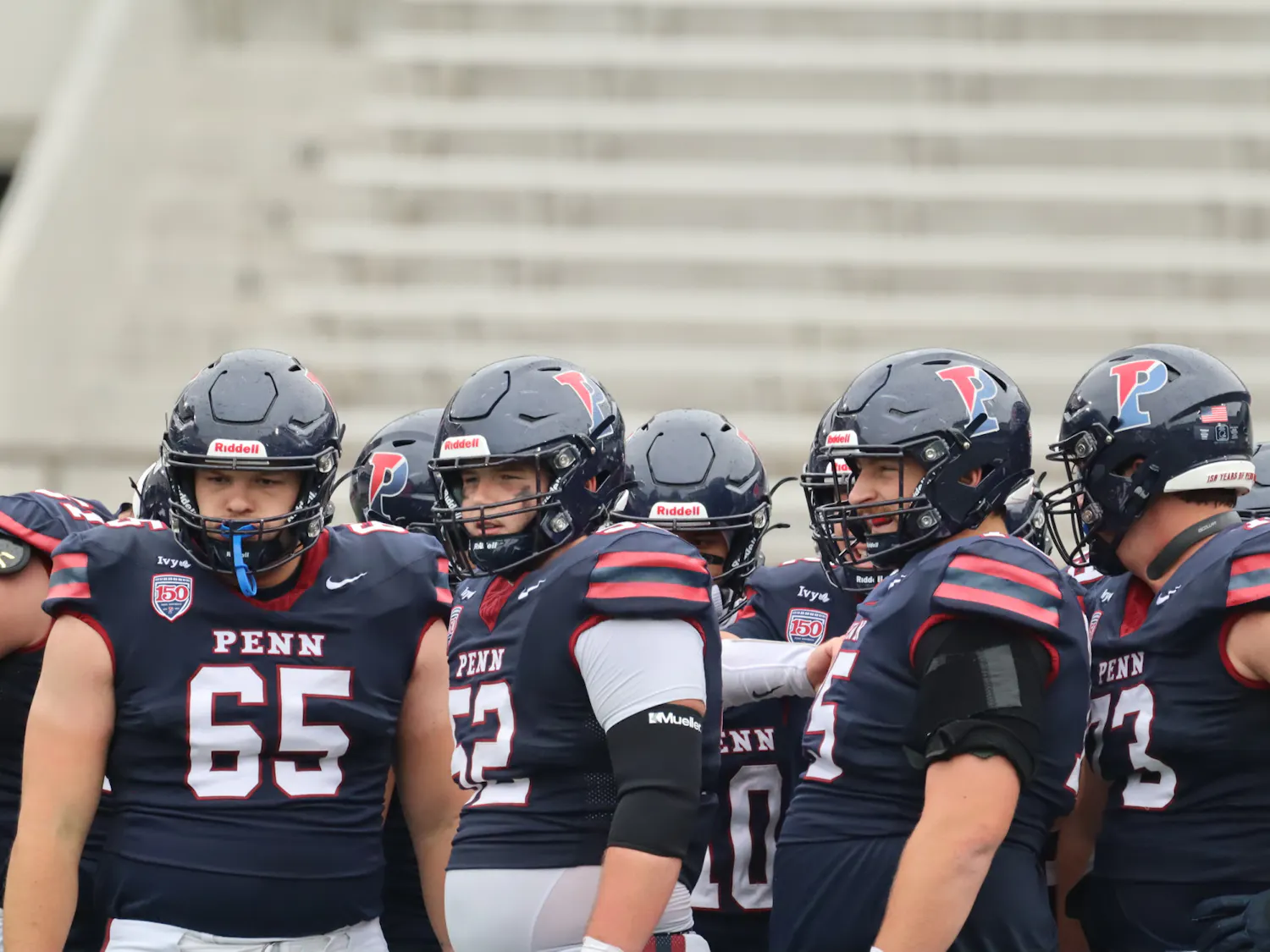
While television coverage of Penn sports from on-campus housing is limited to rebroadcasts on UTV13, what dorm residents may not know is that scenes of victory from Franklin Field and the Palestra are seen in homes throughout the country.
Sporting events from the Penn Relays to the men's swimming championship can be seen on such channels as NBC, CBS, CN8, Comcast SportsNet, College Sports Television and the YES Network.
Ivy League television deals are nothing new.
"We've had TV on and off for about 20 years, ever since the Supreme Court deregulated football in 1974," Ivy League Executive Director Jeff Orleans said.
However, according to sources from Penn Athletics and thenetworks themselves, the school receives nothing more than exposure.
"We don't generate any money from TV deals," Penn Athletics Communications Director Carla Zighelboim said. "But they can take the games and sell ads during commercials. ... It's definitely a two-way street."
YES and CSTV coverage were set up through the Ivy League office. Penn is showcased nationally in various sports along with the rest of the Ancient Eight.
The YES network -- part of the Yankees conglomerate -- shows six Ivy men's basketball games and five football games each year, with every school shown playing both sports.
A YES programmer who asked not to be named said that the Ivy League partnership was one of the first relationships the company initiated and has become one of the more fruitful.
He also said that the Penn-Brown basketball game that determined the Ivy champion last year was one of the most exciting games YES has shown on air.
YES will also show an Ivy League basketball playoff, if necessary.
This agreement is especially beneficial for Penn because YES is available on DirecTV, adding a once-untapped fan base of national Penn alumni to the ratings.
CSTV, another DirecTV channel, shows roughly 15 hours of Ivy footage per year, which usually translates to 7-10 various sporting events, Orleans said.
CSTV has shown events in wrestling, basketball, lacrosse and cross country in the past, and plans to broadcast the Ivy swimming championships later this season.
Soccer and field hockey are two more sports CSTV hopes to add to its Ivy programming next season.
"It's a great relationship," said Tim Pernetti, CSTV vice president of programming. "Alums are all over the country, so for us it's really worked well so far, and will grow over the years."
Comcast SportsNet is the lone network with an agreement directly with Penn -- it airs football and men's basketball games.
Zighelboim also said that networks will call to request games on an individual basis. Some networks that did so this year include MSG, Cox, the Football Network and the Patriot Network.
Penn has broken out of the cable box and hit network television twice each of the past two years -- when the Penn Relays are broadcast nationally by NBC and when the Quakers made the NCAA men's basketball tournament, which is aired on CBS.
Penn sees no monetary returns for either, but once did for NCAA tournament appearances.
The NCAA distributes money to the conferences based on their performance in the tournament over a six-year rolling period. For each game played in that period, a "unit" of money is awarded.
At one point, the funds given to the Ivy League were divided into nine shares, with the team that appeared getting one of the shares and the other eight going to the league office.
Now the entire distribution goes to the Ivy League, an agreement reached by the member schools.
In 2002-03, each basketball unit was worth $130,697. Since the Ancient Eight has played seven tournament games in the last six years, it was awarded $914,879.
"That's a nice sum of money," Orleans said.
Another popular sports network that has played occasional Ivy League games is ESPN.
However, Penn has yet to play a game on the 24-hour sports network this season.
"We call them and tell them we will play when they want us to play," Zighelboim said.
While ESPN makes the final decision on what to air, the Ivy League declined on a possible ESPN appearance last year when it decided not to participate in the mid-major Bracket Buster Saturday, which is scheduled for this weekend.
Princeton has been on ESPN2 twice this season against Oklahoma and Duke, and Yale appeared on the network when it took on UConn in the National Invitational Tournament.
The Tigers have also been featured on the "worldwide leader in sports" for the NCAA lacrosse tournament.
Franklin Field made it on ESPN last season when the pre-game show College GameDay came for the Penn-Harvard game.
That episode of GameDay was the highest rated in the program's history.
With all these networks coming to West Philadelphia, Penn Athletic Director Steve Bilsky stipulated that Penn has "the most exposure in the league."
Even though the television agreements do not translate into dollars and cents, Penn officials agree that the deals are still extraordinarily beneficial.
"It's more intrinsic," said Jim Mesisca, Penn Athletics' director of fiscal operations. "It's not a monetary thing for us. It helps recruiting [and] our alumni.
"Our fan base gets to see it more, and a lot of positive exposure comes from that."