

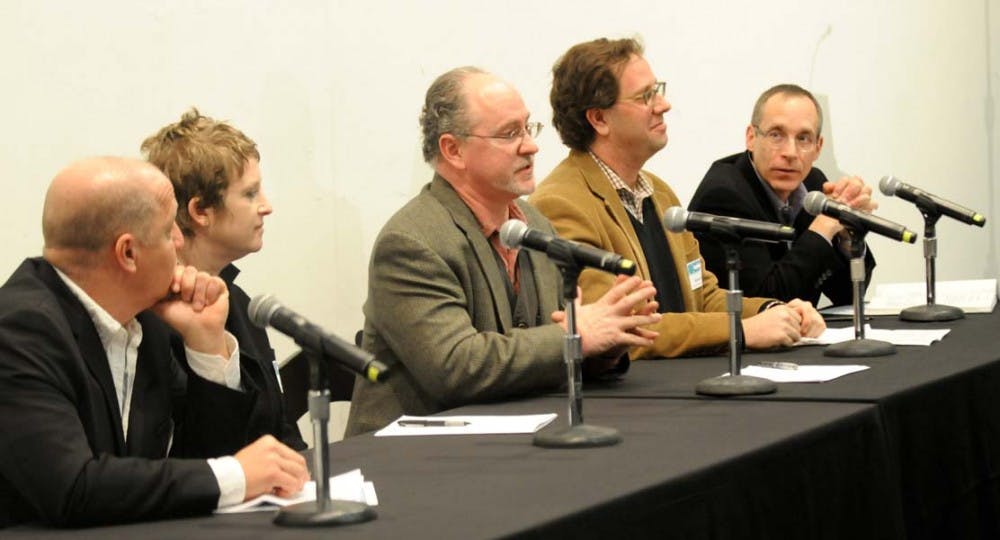
On Friday night, architects, designers and students convened at the School of Design to explore the connection between architecture and its effects on the surrounding climate and region.
The conference, part of the “Architecture and Energy” series, brought experts from all over the world to showcase new concepts of design and shift the current paradigm of sustainability and its relationship with architecture.
The series is a collaborative effort among faculty from PennDesign, Pennsylvania State University’s Stuckeman School of Architecture and Landscape Architecture and the Energy Efficient Buildings Hub — a program funded by the Department of Energy which seeks to improve energy efficiency in buildings.
Faculty from both schools as well Carnegie Mellon University helped facilitate the discussion while more than 200 students and professional architects listened.
“The guy who runs the EEE Hub, a chemical engineer, asked two or three years ago: ‘What style should energy efficient buildings be?’” said William Braham, associate professor of architecture at PennDesign. “And we dismissed the question.”
However, Braham realized that this question brought up a significant point. As other discussions in the past have focused on the intellectual relationships between energy and aesthetics, “this one is more about the work that we need to be doing on the ground.”
The experts who attended not only presented their designs, but also hoped to influence the way students thought about architecture.
“I really wanted to expose people to new ideas at this event but also get young minds thinking differently,” said Mason White, an assistant professor of architecture at the University of Toronto, who gave a presentation.
Related
1/23/13: Athletics Eco-Reps tackle new initiatives
1/16/13: Students and faculty work together to make courses sustainable
“A lot of times students are told the answers instead of told to ask new questions,” he added. He’d rather his students ask, “‘What can I do?’ than say ‘these are the answers and I need to memorize them.’”
Students attending the event highlighted the importance of thinking differently about architecture in order to address the world’s current environmental problems.
“Architecture as a discipline is a lot more than what people think from an art perspective,” College senior Lane Rubin said. “[Architecture] should be something that engages its world in a responsible way. Clearly, we now have an environmental crisis and architecture has the potential to be one of the most powerful tools to adequately address this problem.”
First-year graduate student in PennDesign Nathaniel Hammitt admired Penn’s initiative to serve as a “crossroads” for architects to share their ideas.
By attending, he hoped to see how “everyone can work together in a way that addresses the fact that architectural construction is a huge part of carbon dioxide output in the United States. It’s immense.”
He added, “To see action taken on that would be fantastic.”
The conference was also geared toward increasing dialogue among professional architects about the ethics of their trade.
There is often a debate on this point, Braham said, “because we, as professionals, have forgotten how to design buildings that are connected to climate and really use it.”
The EEE Hub is planning to hold a similar event one day before Greenbuild — a conference dedicated to “green building” with over 30,000 expected attendees and which will take in Philadelphia in November.

