

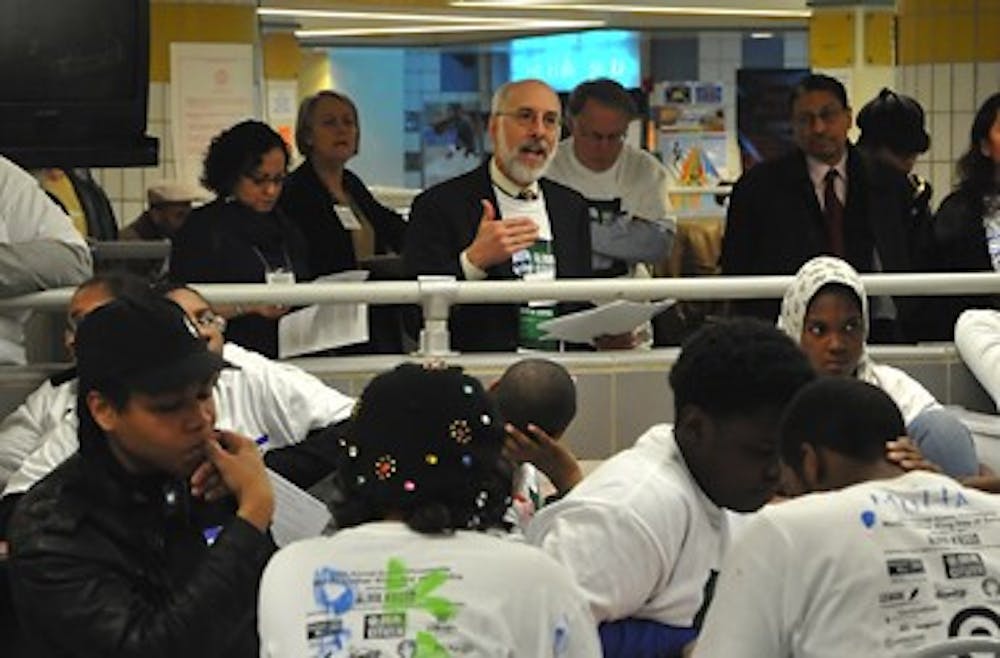
Some younger students qualified Martin Luther King Jr. as “nice,” some lauded his accomplishments, and others admitted to not knowing much about him at all. But Monday, high school students, graduate students, professors and community members gathered to discuss King’s legacy and how it relates to today’s society.
“The Conversation of Kings: From Dream to Sacrifice Toward a More Perfect Union” featured two community forums, one at Girard College and one at South Philadelphia High School, that discussed how to address issues of race and ethnicity.
The event — which was divided into multiple moderated discussion groups — grew out of a partnership between the Penn Project for Civic Engagement and NewCORE, or New Conversation on Race and Ethnicity, an organization committed to furthering the cause of racial dialogue and cooperation.
Common themes discussed included personal experiences with racism and plans to improve race relations. Many participants offered their own takes on how far society has come since the civil rights movement and King’s “I Have A Dream” speech at the March on Washington in August 1963.
Students from five Philadelphia high schools shared their thoughts on inequalities in their own schools and neighborhoods, but also told stories of interracial cooperation and friendships.
Much of the discussion centered around education and the importance of equal access to education as a means of social advancement.
“There was an equal amount of hope and discouragement discussed,” according to moderator and PPCE member Donna Alonso. But having the dialogue in itself was productive, she added.
“Today made a difference,” Alonso said. “There’s a lot of hope, but it’s also no time to sit back and say ‘we’ve made it.’”
School of Social Policy and Practice student Abigail Reikow was “happy to see youth on their day off come and have a heavy and intense conversation.”
She urged Penn students to be more mindful of the community around them.
The only way to deal with race-related issues is to discuss them, PPCE director and Graduate School of Education associate professor Harris Sokoloff said.
“We’ve come a long way since then, but not far enough,” Sokoloff said.

