

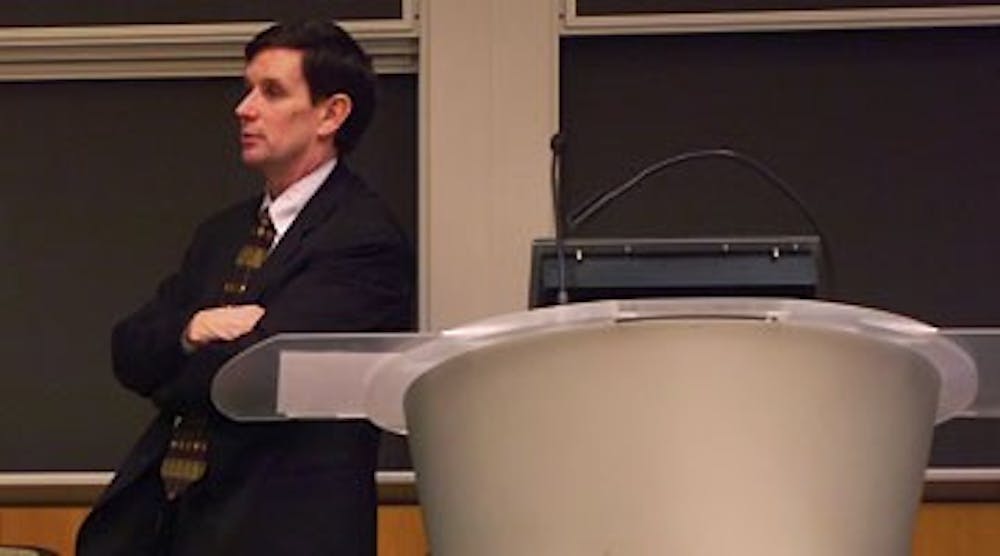
Last night, Political Science professor Rogers Smith discussed his hopes that the closing of the U.S. Naval Detention Center in Guantanamo Bay, Cuba, will bring about positive changes in the new presidential administration's methods for dealing with human rights issues.
In an event organized as part of the Penn American Civil Liberties Union's Rights Week, Smith lectured yesterday in Huntsman Hall on the legal issues that have surrounded the center over the past eight years. The talk was co-sponsored by Penn's chapter of Amnesty International, a human rights organization.
Guantanamo Bay has held detainees, classified as "enemy combatants," since the terrorist attacks of Sept. 11, 2001, Smith said. Last month, President Barack Obama signed an order to suspend the proceedings of military commissions. The detention facility will be shut down within a year.
Smith explained that the human rights of the detainees have been continuously violated over the past eight years. He focused on the history of suspending and upholding Habeas Corpus - which says the government must show evidence before a military trial and the suspect has a right to request a review by the civilian court.
Smith said in setting up military commissions to try Guantanamo Bay captives and passing the Military Commissions Act of 2006, the executive branch and Congress truncated Habeas Corpus and human rights.
He added that this statement was supported in cases like Boumediene v. Bush in 2008. During this trial, the Supreme Court challenged the legality of Lakhdar Boumediene's detention at the Guantanamo Bay military base, ultimately ruling that prisoners had a right to Habeas Corpus under the U.S. Constitution and that the Military Commissions Act was unconstitutional.
Smith said he hopes Obama's administration will bring a civil liberties regime which conforms to traditional American civil rights.
In the discussion following the lecture, however, Smith expressed concerns for the new administration.
"If we consider the human rights of the prisoners of war and send them to ordinary civilian court, the lack of evidence against the criminals will ... make the situation too dangerous," he said. "We need special military court for the prisoners of war because the evidence comes from torture or undercover form, unlike in an ordinary criminal trial."
College junior Andrienne Benson said she thought the lecture was "comprehensive and well-informed."
"All Penn students should know more about U.S. government and human rights," she added.

