

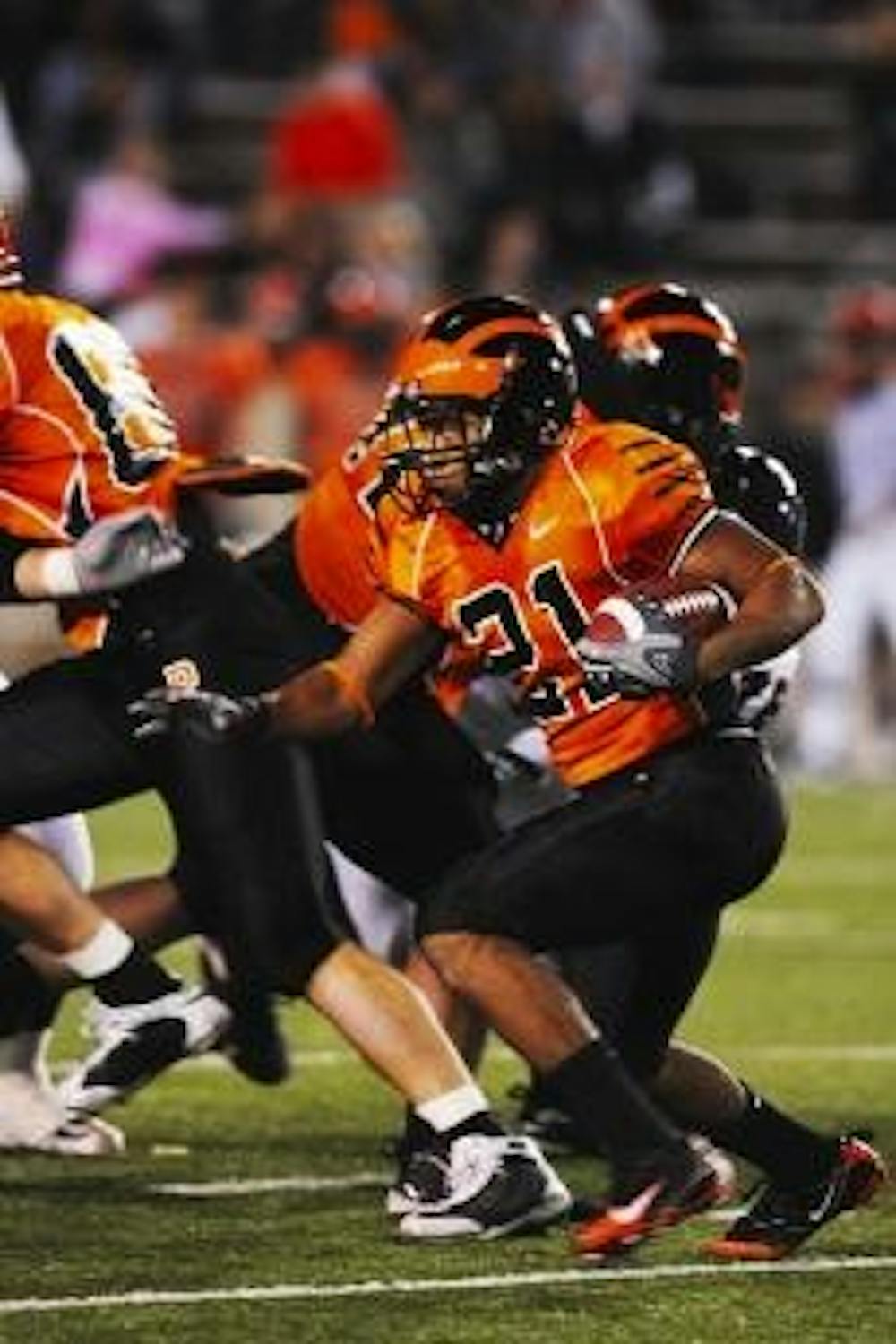
PRINCETON, N.J. - The Tigers came into Friday's game ranked first in the Ivy League in rushing offense and last in passing offense.
All that, and Princeton coach Roger Hughes was still surprised by how much the Quakers geared up to stop the run.
But stop the run they did. Princeton was forced to rely on the weaker half of its offense, and quarterback Brian Anderson could not quite muster the oomph the Tigers needed in the second half of their 14-9 loss.
The Penn secondary, which at times has been the Quakers' best offensive weapon as well, gave up 204 passing yards and produced no interceptions. But it dramatically limited the effectiveness of Tigers running back Jordan Culbreath after a key second-quarter play.
From the Princeton 38, Anderson completed a 24-yard pass to Culbreath. But as the tailback went for the sidelines, three blue uniforms converged and hit him simultaneously. All of a sudden, Penn defensive back Jonathan Saelinger was strutting across midfield, ball in hand.
The ESPNU replay raised questions about whether Culbreath fumbled the ball before his knee was down - asked after the game, he had a simple answer: "No" -- but the referees signalled Quakers' ball.
Princeton recovered momentarily and even scored on the next drive, but Culbreath was never the same. Of his 109 total yards (57 rushing, 52 receiving), just 33 came after that play.
"Pretty much every defense has been keying on me, and I accepted that today," Culbreath said.
After the game, Culbreath could only take a few brief questions before he was forced to sit down and give his legs a rest. He didn't know on Friday what exactly had happened to him; Hughes speculated that his hamstring may have been overextended by the hit.
"Jordan Culbreath doesn't fumble the ball," Hughes said. "That kid's a warrior, and for him to fumble, he had to have been feeling some pretty acute pain."
Without a fully functional Culbreath for much of the second half, the Tigers' convincing play fakes virtually vanished. Anderson was under pressure more often, and Princeton's running game suffered.
"They run a lot of option, a lot of wide set packages," said Quakers defensive back Kevin Gray, who scored a couple of shots on Anderson early in the game. "Our coaches were great. They knew almost everything they were going to do."
The Tigers' reliance on the pass came back to bite them on what turned out to be their last drive. Princeton got the ball down by five points with 7:24 to play. It advanced to its 44 after two 10-yard rushes and a personal foul on Penn. But with time running low, Hughes thought that the Tigers would get the ball back, at most, once more.
So to save time, he called three straight pass plays. After two not-even-close lobs, Anderson had receiver Adam Berry open on the left sideline and simply overthrew him.
Princeton punted on fourth-and-10, and Penn produced three first downs to run out the clock. That left Hughes wishing he had taken his best shot, with the ball in the hands of his star.
One positive-yardage play, he said, and he would have gone for it on fourth down.
"Fourth and medium, you go for it," he said. "Fourth-and-10 ." he started, but then his voice trailed off.
Related StoriesFootball | Hail to the Keiff - SportsBernstein | Stars finally aligning for Bagnoli - SportsFootball | Less practice, more coverage - Sports

