

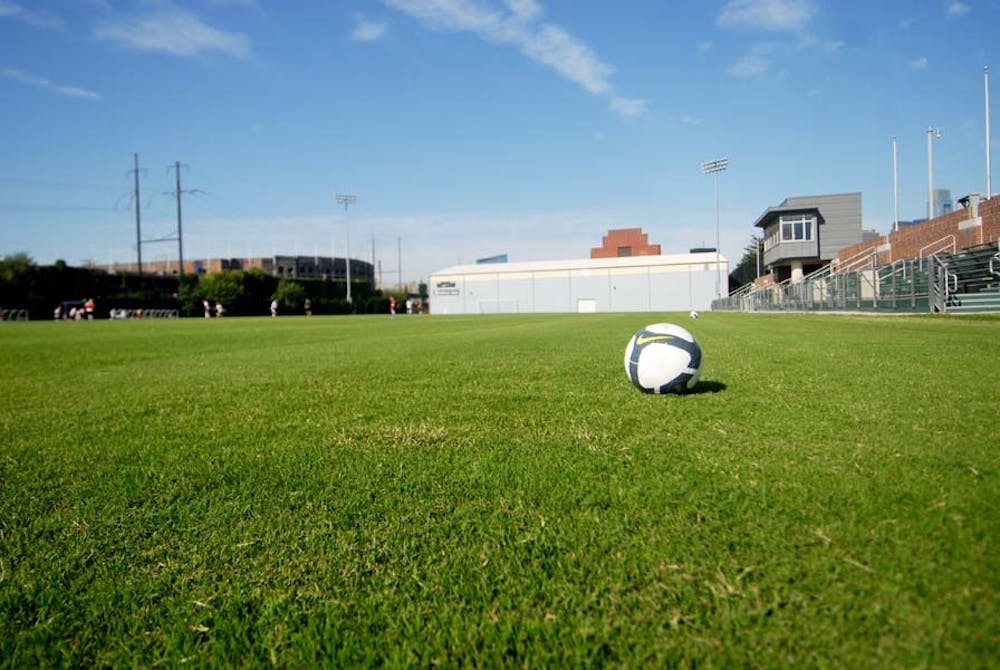
Last year, Rhodes Field was plagued by maintenance issues. To fix the problem, the Athletic Department did more than repair Penn's soccer field - it completely changed the grass.
The Bluegrass that served as the playing surface since Rhodes opened in 2002 was eliminated in June, and Riviera Bermuda grass was planted in its place. The new grass should ensure that the field remains level and is easier to maintain.
"It's a heartier grass; the roots are much stronger, they go down much deeper," said Dave Bryan, director of athletic facilities and operations. "This surface is very smooth. If you mow it very short, very tight, they're getting a very good ball roll. The previous service had a lot of divots, and that would be a problem."
Riviera Bermuda grass is a strand of the Bermuda grass that has become popular for athletic fields across the nation. Numerous schools - including Virginia Tech, Purdue and Penn State - have installed Bermuda grass on some of their athletic facilities.
Last year, Penn installed Patriot Bermuda grass on the infield of its baseball field, Meiklejohn Stadium. Members of the Athletic Department, pleased with the results, again looked to Bermuda grass to fix a turf problem, and men's soccer coach Rudy Fuller and women's soccer coach Darren Ambrose were both involved in the decision process.
"At the end of the year, we always evaluate where we are and how we could do things better," Fuller said. "One of the things we talked about last year was possibly improving the field. We looked into it and it became a possibility, so we moved forward with it."
The Athletic Department consulted Mike Boekholder - head groundskeeper for the Phillies and friend of Penn baseball coach John Cole - who had worked on Meiklejohn. He recommended Riviera Bermuda grass, a strand developed at Oklahoma State University that served as the playing surface for baseball at the Beijing Olympics.
Riviera Bermuda grass is different from its Patriot counterpart and other strands due to its ability to survive harsher weather. Thus, it is more suitable for a northern school like Penn.
"[Bermuda grass] has always been a preferred surface," Fuller said. "But up until just recently, you couldn't grow Bermuda grass this far north."
The turf is also notable for its quick growth. The seed was applied on June 11 and was ready to go for the team's first practice on Aug. 21. According to Bryan, the grass will have to be mowed more frequently than before - three to four times per week.
And thus far this preseason, it hasn't fallen victim to the wear and tear that has damaged the grass in years past.
"Any time we can do something that's going to improve [the team's] experience, it's good for them," Fuller said. "We're all excited for the new field and the new surface, and we're looking forward to playing our first game on it."
But despite the excitement, Bryan wants to withhold judgment on the surface until the end of the season. Frost and cold weather are usually the biggest threats to Bermuda grass fields.
"So far, so good," he said. "It will be interesting to see what happens in October and November, because right now, with the heat, that type of grass flourishes; it does really, really well. Toward the end of the season when it cools down, we'll see how it goes."
Related StoriesPenn is happy to be Phillies' guinea pig - Sports

