

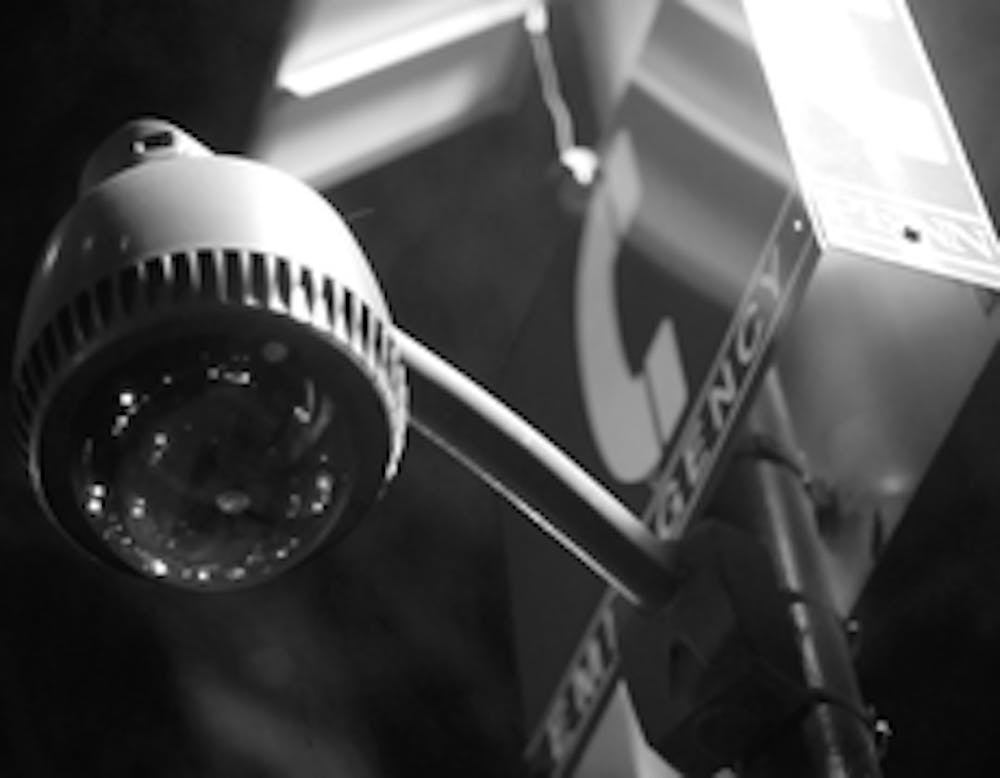
Be careful - Big Brother might be watching.
Penn is continuing ongoing efforts to expand its use of surveillance cameras on and around campus, though outside groups have expressed concerns about the cameras' effectiveness in crime prevention and the potential for privacy violations.
Currently, the University has approximately 500 surveillance - or CCTV, cameras in place, said Rick Sanfilippo, the Division of Public Safety's assistant director of Security and Technical Services.
Of those 500 cameras, 86 are "point-tilt-zoom" devices, which are able to be remotely operated.
Costing about $32,000 each, the University plans to continue adding seven PTZ cameras a year as crime-prevention devices, Sanfilippo said.
"It's a proactive tool that's been proven very successful in crime prevention . and investigation," Vice President for Public Safety Maureen Rush said.
Still, some dispute the ability of surveillance to prevent crime.
"This is a drain on resources that doesn't work," said Matt Faiella, a lawyer for the New York City chapter of the American Civil Liberties Union.
Ann Franke, president of Wise Results, a firm that advises colleges on legal risks, said, "There's the possibility that cameras will deter crime, but those reductions can then be offset by increases outside the camera's range."
But crime at Penn has experienced an overall decrease of about 40 percent from 1996 - when the University first began installing cameras - to 2007.
Rush said it's difficult to ascribe a drop in crime to any single factor, but said CCTV cameras have been used to stop potential crimes and aid investigators.
After "suspicious behavior" draws the attention of an officer remotely monitoring an area, police can intervene when they "know they're going to do something," Rush said. Most individuals arrested in these scenarios have warrants for previous crimes, she added.
However, "we need to keep better track" of violent crimes stopped in progress due to the cameras, Rush said.
Still, privacy groups remain wary of the potential for abuse of surveillance technology.
"The public isn't aware of their presence or capabilities," said Bill Brown, co-founder and director of the Surveillance Camera Players, which stages protest performances in front of surveillance cameras.
"These cameras have the ability to read the text messages off your phone," Faiella said. "There exists tremendous potential for the government to profile individuals using images of private acts captured from semi-public locations."
In recognition of these concerns, the University has taken several steps designed to inform the public and curtail the potential for abuse.
Currently, there are "at least 86 signs," Sanfilippo said, declaring the presence of a camera. The locations of cameras are also published in the Almanac and on the DPS Web site, he said.
Penn also has a CCTV policy outlining procedures aimed at preventing misuse and designating a seven-member "monitoring panel" with the responsibility of ensuring the policy's adherence.

