The Penn baseball team may have the Phillies' infield of the future.
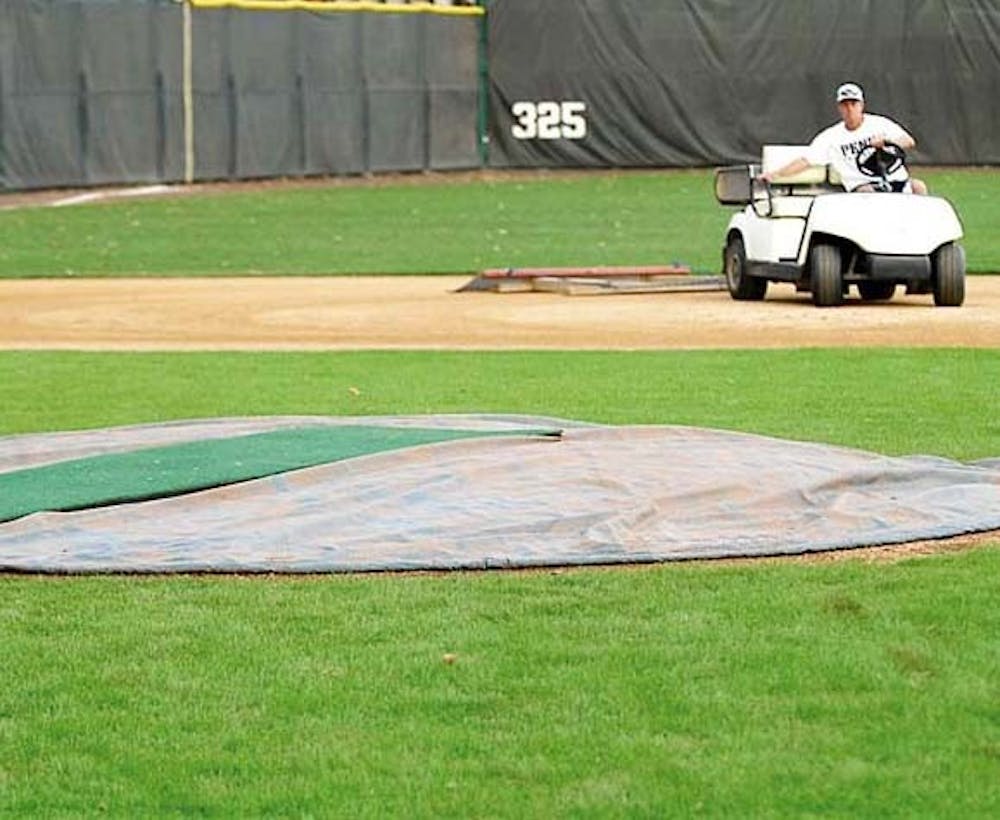
No, Quakers coach John Cole is not grooming Steve Gable and William Gordon to replace Chase Utley and Jimmy Rollins. But Meiklejohn Stadium received a grooming of its own this off-season, and the Phillies have shown particular interest in the new surface.
The infield grass of the seven-year-old stadium was replaced with Patriot Bermudagrass, a hybrid patented by Oklahoma State University scientists three years ago.
Yet while the exact terms of the partnership are unknown, the Phillies did foot a large portion of the bill for the new turf, according to Director of Penn Athletic Facilities and Operations David Bryan.
The breed "produces a high quality of turf suitable for most turf applications including .athletic fields," the patent reads. It was designed to thrive in cooler climates than traditional bermudagrass, which is only grown in the South. Many collegiate and professional football teams - including the Philadelphia Eagles - have switched to Patriot in recent years, but its use for baseball is relatively new. Cole said that he believes the Quakers are the only baseball team, at any level, north of the Mason-Dixon line to play on this grass.
"The Phillies are interested in how it can work in a baseball application in this climate," said Bryan. "So they were talking with [Cole] and they offered to install it on our field."
Bryan said he "can't answer" whether the Phillies would consider replacing the grass on Citizens Bank Park, which opened in 2004. Phillies Head Groundskeeper Mike Boekholder, who led the team's effort in this initiative, did not return repeated phone calls, and the organization declined comment.
"It was a very good arrangement, a very good proposal," Bryan said. "It was something that I guess you could say was too good to pass up."
Cole said that, while the cost is "not anybody's business, it was pretty cheap to pull off" thanks to "innovative financing."
That innovation consisted of cooperation between Penn's athletic and facilities departments, the Phillies and outside contractors. The infield was installed during the summer while the Phillies were on a long road trip.
The Quakers are hoping that the bermudagrass will live up to its billing and prove to be more durable than the bluegrass it replaced. A Purdue University agronomist once compared the bermudagrass to a pickup truck-"it wants to be beat up, and it wants to take the load."
Patriot grass thrives in the summer, allowing it to choke out the weeds that usually overtake Meiklejohn Stadium. In cooler weather, the dormant grass turns brown, so it will be overseeded with rye grass to keep its pigment.
"It will give us a nice spongy surface to play on, similar to what artificial does," Cole said. "It prevents a lot of wear and tear, it absorbs water better, and it remains green."
Penn is hoping that Patriot's strength will help reduce maintenance costs.
And although Cole said it was unintentional, he sees another possible benefit for the Quakers. Because they play in a small ballpark, their pitchers need to keep the ball down in the strike zone.
"This surface is conditioned for ground balls," Cole said.
So far, only the infield has been replaced; the outfield still has the original bluegrass. Bryan offered two explanations.
"We don't know how it's going to work for us, honestly," he said. "This is somewhat of an - I hate to say it - experiment."
He also admitted, however, that the infield was "the only thing we could do at this point."
There are currently no plans to replace the outfield, nor has the Athletic Department even held discussions about that possibility. Bryan did leave open the idea that, if successful, this bermudagrass could be used on other athletic fields at Penn.
For now, though, Bryan, Cole and the Phillies can only watch and wait to see how this experiment ends.