

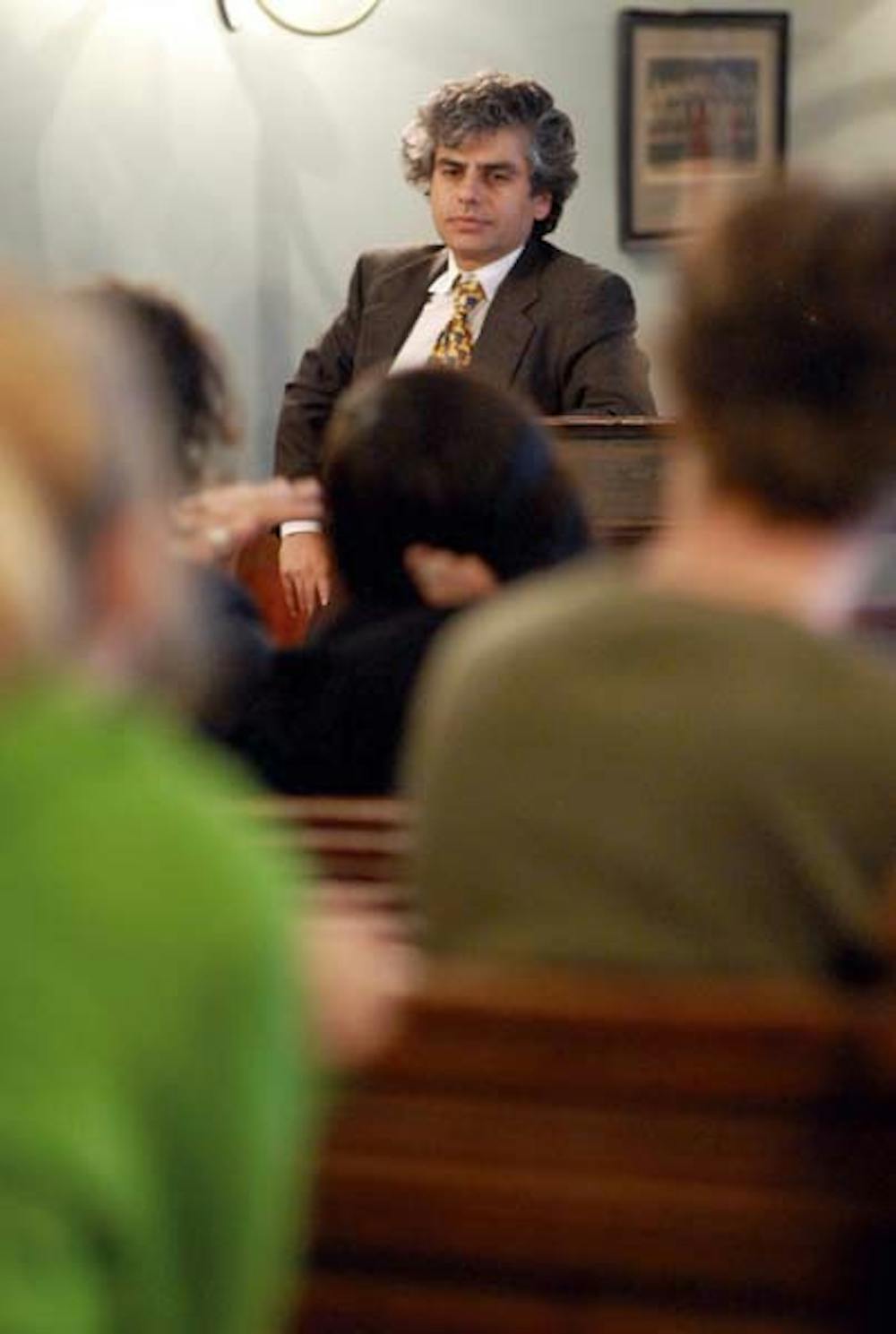
What happens when Muhammad meets Mona? The Philomathean Society led a debate over art and politics about that very question last evening at College Hall.
Philo, the oldest continuously existing literary society in the country, hosted Penn's own Jamal Elias, chairman of the Religious Studies Department for the discussion.
Elias talked about the Taliban's destruction of Buddhist statues in Afghanistan in 2001 and described the significance the event holds for the wider clash of art and religion.
Elias attributed the destruction of the Buddhist statues to a desire among extreme factions of the Taliban to erase "pre-Islamic icons" in Afghan society.
Many international organizations attempted to rescue the statues from destruction. According to Elias, India even offered a safe haven for them, but the Taliban refused.
Elias said the Taliban could not afford to be "complicit" in the promotion of pre-Islamic beliefs throughout the region. And since there was no religious reason to preserve the statues, which had survived Islamic rule for more than 1,000 years, they were destroyed.
In a Q&A; period following the lecture, Art History professor Robert Ousterhout asked, "Why did we react with more outrage over the destruction of [the statues] than the humanitarian crisis that the Taliban created?"
This question loomed over the rest of the discussion. As Elias reminded the audience, nearly 20 percent of Afghanis are still refugees across the border in Pakistan six years after the American-led invasion.
Walt Hakala, a fourth-year School of Arts and Sciences graduate student, asked whether the destruction of Buddhist icons indicated a "conquest" by the Taliban on the Indian elements of culture that spread into Afghanistan.
As Elias explained, Muslims are indeed "anti-icon" but typically "don't go around destroying them."
The source of the Taliban's frustration, Elias noted, was that they saw organizations prepared to pay for the removal of the statues but not to help the Afghan people or their economy.
Philo's event organizer, College senior Joshua Matz, ended the event by asking Elias the moral of the evening's discussion, particularly whether it was to "understand and engage" or to "know thine enemy."
Elias had no one answer to this question but suggested that "the values of life over material objects" was the crux of the debate between art and religion.
"This is a warning to us," he said.

