

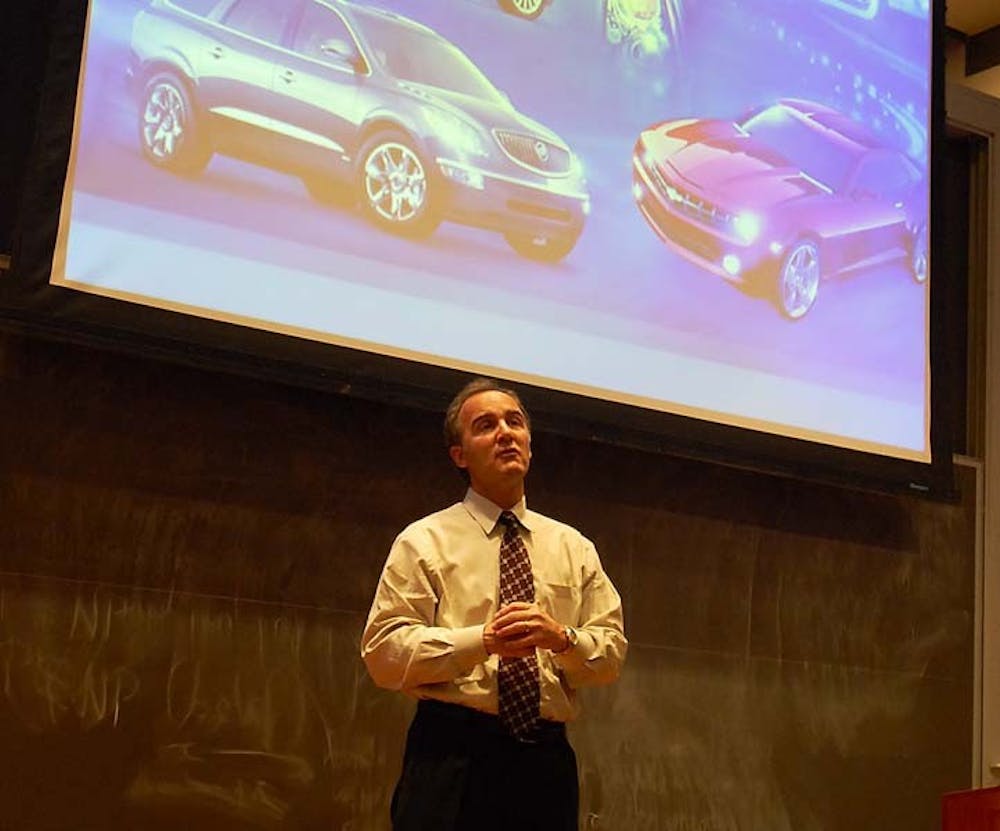
According to General Motors executive Larry Burns, it may take "changing the DNA" of cars to solve the environmental problems of the automobile industry.
Burns, GM's vice president of research & development and strategic panning, discussed goals for the future of GM and the automobile industry yesterday evening before an audience of a few dozen Engineering students and professors at Levine Hall.
Burns said GM's goal is to "reinvent the automobile" by making it more "exciting and affordable," as well as safer and more energy efficient.
He cited both the potential of the automobile in the future but also said he is aware that major changes in fuel sources, as well as ensuring that cars continue to meet the increasingly high standards of potential buyers, is "critically important."
"Our first objective is to keep our consumers happy," he said.
And, in the future, he predicts that the public infrastructure will create a necessity for more energy efficient cars.
"For business reasons, we have to diversify energy sources and replace petroleum," he said, adding that he is also "anxious to work with government to solve these problems."
And with that focus in mind during this presentation, Burns discussed a number of examples of GM cars that, in the near future will combine energy sources like hydrogen fuel cells, ethanol and electrical power as well as petroleum.
He also pointed out that GM is already beginning to produce several hybrid cars like the Buick Enclave and Saturn Arcadia.
Burns said he is excited about how the world automobile market will change as GM changes.
"What's really unique to GM is our global footprint," he said.
General Motors produced 9.1 million automobiles in 2006 and controls 12 brands, including Chevrolet, Cadillac, Saturn and Pontiac. That wide range of production is important, Burns said, because "diversity drives innovation," and, "when GM technology is right, it affects a lot of people."
OnStar, he said, is a prime example. "What it creates is vehicle to vehicle communication," he said, a technology that in the future may get "to the point where a car can drive itself."
Burns' mood was idealistic and optimistic about the future, and many in the small audience reciprocated that feeling.
Engineering sophomore Jeremy Estey said he found the talk informative because he's "excited about how the auto industry is advancing," he said.
Jason Thompson, a graduate Engineering student who has heard Burns speak before, agreed.
"It sounds like they're achieving some milestones," he said. And in his experience, he added, Burns "means what he says."

