

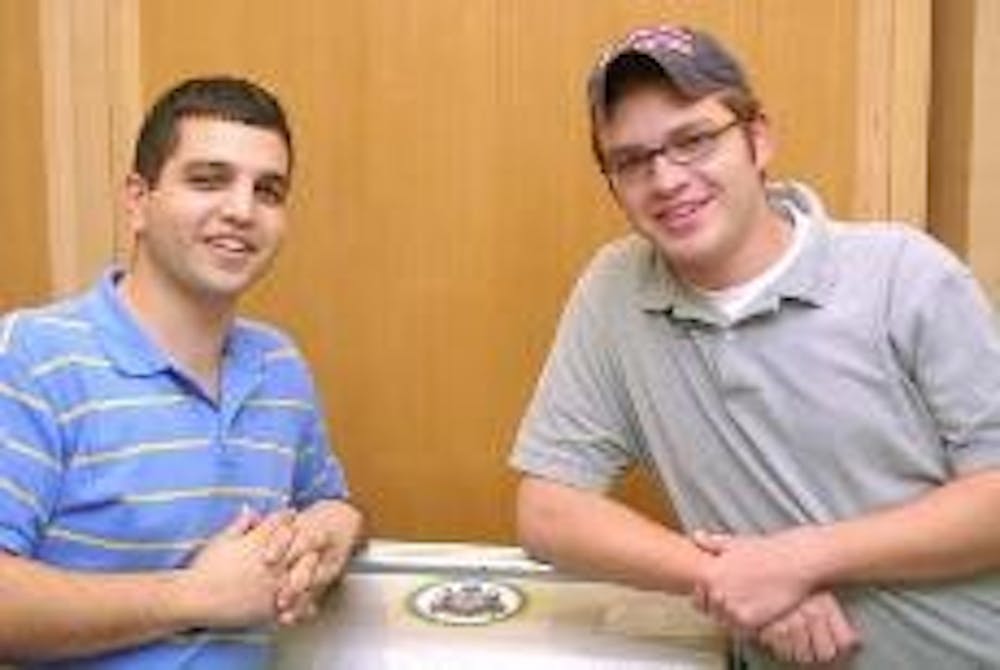
For College senior Ezra Billinkoff, May 16, 2006, was a day of waiting.
And waiting.
And more waiting.
It was the day of Pennsylvania's primary election, and during Billinkoff's 13 hours serving as an election judge, exactly seven voters came in to Steinberg-Dietrich Hall and gave him a reason to get off his chair and help them vote.
Billinkoff is one of several Penn students who will be serving as poll officials at locations on and around campus in Tuesday's election.
The job seems to be thankless; it involves long hours, a meager salary and no tangible benefits.
But according to the students who fill the positions, the real reward lies in the ability to take part in the political process.
"When you open those polls, you're ensuring that democracy is persisting," said College senior Dean Panayides, who serves as the election judge for the 27th Ward's 21st Division and was a tad busier in May, aiding 17 people. "If I hadn't been there, those 17 voters couldn't have voted. That means a lot."
With no high-profile races on the ballot and Election Day set for the day after graduation, the low May turnout was expected, but the students working in the upcoming general election expect to be a little more preoccupied this time around.
"I'm definitely looking forward to it," said College senior Meredith Uhl, who is the judge of elections in the Ninth Division. "It seems that a lot of organizations have done a lot of good work. . I'm hoping we'll see a big turnout and a lot of people being excited for the candidates."
A full staff of poll workers includes an election judge, who is technically in charge of the polling location, a clerk, a machine inspector and an inspector from each of the two major parties.
The machine inspector is hired by the city, but the remaining positions are either popularly elected or appointed, often given to anyone who is willing to spend an entire day at the polls twice a year.
That's where Penn students come into play.
City election code requires that judges and inspectors of elections must live and be registered within the division, which is often an area with only a two- or three-block radius.
Five divisions consist solely of campus housing and three more have mostly student residents, which translates into a need for dozens of Penn students to fill the positions in University City.
As a result, both the Penn College Democrats and College Republicans have recently taken an active role in trying to recruit candidates for each job.
"We saw it as an opportunity to get our members involved in the ground level of politics and . we wanted to ensure that local elections would be conducted fairly and responsibly," Penn Democrats spokeswoman Connie Meng wrote in an e-mail interview.
The judge and inspector positions are on the ballot every four years, and were last elected in 2005.
In order to run, students must get 10 signatures from registered voters within the division and win both the primary in May and the general election in November. The losing party is often assigned to the minority inspector post in order to ensure bipartisanship.
The system is designed to give representation to both parties to derail any chance of voting fraud. And while the College Republicans usually have little trouble ensuring that each polling station on campus has a Republican representative, that's not necessarily the case in other parts of Democrat-heavy Philadelphia.
As a result, the organization has found between 30 and 40 students to work as poll watchers in locations where the election staff is made up solely of Democrats.
"We just feel it's important that both sides are heard and that the integrity of the election is preserved," College Republicans President Michael Shiely said.
Nineteen Penn students were elected to positions on or around campus last November, though some have since graduated.
According to Panayides, the thrill of victory last year was a little delayed, as the results usually take weeks to be officially counted due to the positions' low profile.
But Panayides said it was a "great feeling" once he finally received word of his win.
"When I got that blue piece of paper in the mail as a judge, I felt like this is it. This is my first official role of giving back to the community," he said.
Since then, those elected have had to undergo an hour-long training session and serve during the May primary, where polling places only saw traffic reach between five and 25 people.
Better turnout than that is expected on Tuesday, but it brings the possibility of more problems in which anything ranging from voter machine breakdowns to voter complaints could occur.
Broken voting machines plagued the city in the May election, but Panayides said he and other officials will be prepared for any difficulties that arise.
"Every judge and every poll worker gets a ton of materials telling specifically what to do in case of voter disputes and other problems," he said. "I'm not worried and if it does come to that, I'll have no problem rendering a decision."
As for Billinkoff's day of boredom in May, it did come with an unexpected surprise - one of the seven voters was University President Amy Gutmann, who Billinkoff said was thrilled to interact with students.
Other than that, he read and hung out with friends for most of the day, waiting until he could close down the polling station.
But in Billinkoff's opinion, the day was far from a waste.
"I think I've gotten a kind of renewed sense of what civic participation is," he said. "It takes different shapes for different people, and I've really come to respect that."

