

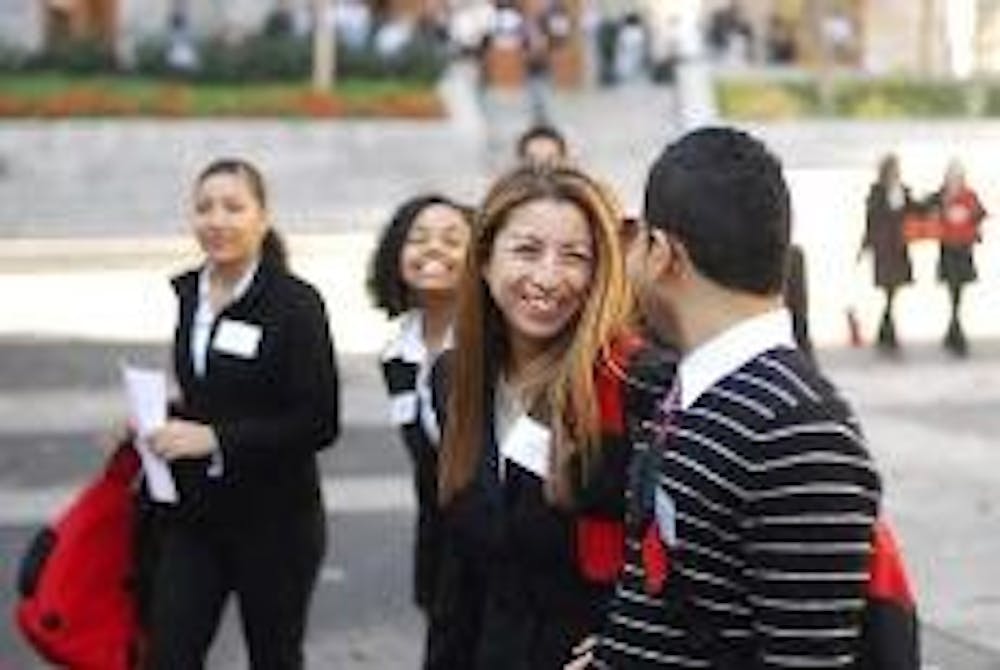
A slice of the Ivy League's Latino community came together in Houston Hall over the weekend.
Their purpose: to connect with other successful Latinos, both students and professionals.
Friday though Sunday, Penn hosted the second annual Latino Ivy League Conference. Delegates from all eight Ivy League schools - about 80 students in all, more than twice as many as last year - attended.
The conference was founded at Penn in 2005. On the agenda this year was an attempt to identify common concerns Latino students face throughout the league and an effort to provide attendees with career guidance and networking opportunities.
Student leaders from Penn's La Casa Latina and Latino Coalition organized the conference, and because it was sponsored by companies such as Lehman Brothers and PepsiCo Inc., the event was free to delegates. A Lehman representative spoke on Latinos in business, and was sure to remind the audience to consider the company as a career option.
More students were able to attend this year - about 30 came in 2005 - because of increased funding from sponsors, and leaders are optimistic that there will be a good turnout when the convention moves to Dartmouth next year.
"We're all facing the same issues of trying to get more influence, trying to get our voices heard," said Stephanie Carrion, a sophomore at Cornell University and a first-time delegate.
Stephanie Rodriguez, also a Cornell sophomore attending the conference for the first time, added that the Ivies have a responsibility to encourage more Latino applicants.
At a panel for students interested in careers in media, Marangeli Mejia-Rabell, who has worked in non-profit communications and now manages her own company, advised delegates to strike a balance between playing the game and staying true to their backgrounds.
"Never compromise your sabor, your personality," she said, before admitting that "I've been called loca from time to time."
Abe Amoros, a spokesman for the Pennsylvania Democratic Party, reinforced that message by telling students to stay connected to their heritage.
"When you graduate with those wonderful degrees, you have a responsibility to give back," he said.
One way to do that, according to Amoros, is for the students to expose perceived injustices in their new careers. For example, Amoros said that when he was working as a reporter, his editor told him not to write about Puerto Rican businessmen because their businesses were likely to fail within two years. Amoros said he went around his editor and ended up writing a profile of a Puerto Rican business owner who continues to be successful.
The conference's keynote speaker was Pedro Ramos, a Penn alumnus and now the managing director for Philadelphia, giving him broad oversight over city government.
Ramos encouraged attendees to consider pursuing doctorates both to advance their own careers and as an antidote to the relative lack of Latinos in academia.
"The Ph.D. train is leaving. There are no Latinos on it," Ramos said.
For Columbia University senior Alma Cadenas-Molina, a returning delegate, some of the enthusiasm surrounding the conference stemmed not from what it has already achieved, but what it has the potential to achieve in the future.
"It's very exciting to think that this can grow to be something so huge, to say I was a founding member," she said.

