

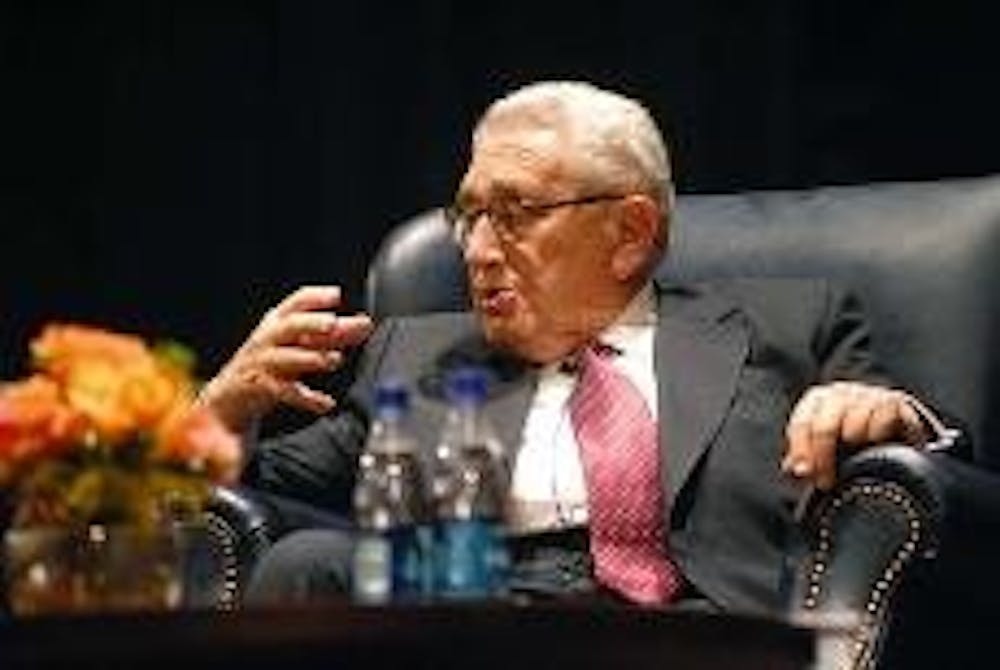
Henry Kissinger, secretary of state during Vietnam, said last night that the current war in Iraq echoes the earlier conflict.
"Americans want to compromise, but to our enemies, compromise equals defeat," he said.
Kissinger, who served under Richard Nixon, was brought to Penn by SPEC Connaissance and the Office of the Provost. The presentation took the form of a question-and-answer session.
Penn professor Avery Goldstein posed questions to Kissinger, 83, in the first part of the program, and students were allowed to ask questions in the second part.
Though he received a standing ovation at the end of the evening, not everyone was excited about Kissinger's presence on campus.
College freshman Paul Augenbraun helped organize a small protest in front of the venue which consisted of students and members of the International Socialist Organization.
Augenbraun accused the speaker of being a "war criminal," saying that "he is at the helm of America's imperialist foreign policy."
Kissinger addressed current global events as well as those of his time as America's chief
diplomat during the event.
Asked to compare Vietnam with the current situation in Iraq, he said that both are characterized by America's trouble fighting a guerilla war, and that America's past and present foes are committed to their ideology.
Kissinger also compared fighting terrorism to the Cold War.
He said he believes fighting the Soviet Union was easier because, as a nation, it was confined to a location and its ideology was secondary to its goals.
"The ideological component became less important because of somewhat imperialist actions of the USSR trying to expand its sphere of influence," Kissinger said.
This contrasts with his view of terrorism having "no locus" and the ability to "submerge and emerge" at will.
Kissinger also discussed his role in shaping U.S.-China relations as secretary of state. He said that before the two countries engaged in diplomatic relations, China was outside the international system and was considered a "loose cannon."
He said engaging in negotiations with China reassured the American people that the U.S. government had good intentions.
"It proved that the government was dedicated to global peace in this time of conflict in" Vietnam, Kissinger said.
He then discussed modern-day relations with the Chinese.
Kissinger said that global politics is shifting from a trans-Atlantic point of view to a trans-Pacific focus, and that the emerging Chinese economy will have important implications for foreign policy.
When asked by a student if he has felt any divided loyalties because he is German-born, Kissinger said that this was never the case.
"The experience I had in Nazi Germany did not inspire excessive loyalty," the Jewish Kissinger said.

