

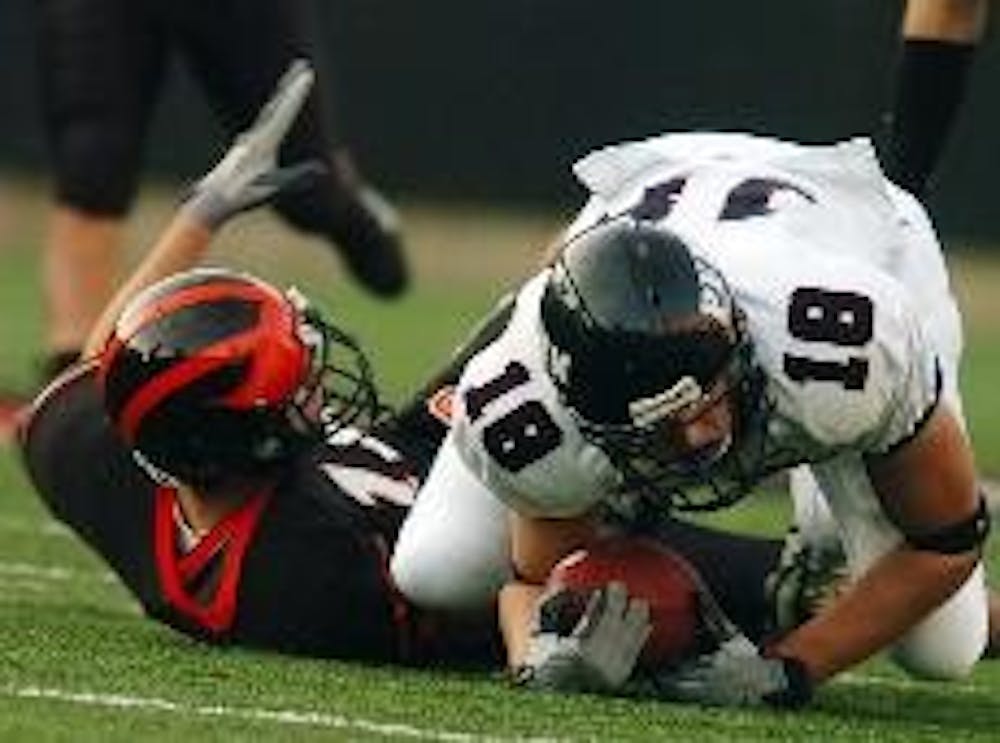
PRINCETON, N.J. - When the dust had settled at Princeton Stadium on Saturday, the Quakers had earned themselves yet another overtime loss.
Understandably, nobody on the Penn side was lining up afterwards to discuss the positives of the game - after a loss like that, there certainly wouldn't seem to be any.
But while nothing can put them back in contention for the Ivy League title, the news wasn't all bad: The Quakers offense showed quite a bit of improvement, and did something it couldn't in the previous few games. It demonstrated an ability to make big plays at important times - something that hadn't quite been present in the last two losses.
Just minutes into the fourth quarter, a Princeton touchdown put the Quakers 14 points out.
But on the next drive, when a penalty eventually resulted in a 4th-and-18 from the Tigers' 23, the Quakers responded in a big way. A Matt Carre reception brought Penn to the 1-yard-line, and sophomore quarterback Robert Irvin took it in himself to finish the series.
And with two minutes to go and the Quakers still down by seven, seldom-used Billy May caught a 29-yard bomb to convert a 4th-and-24, followed by a touchdown three plays later in the closing seconds.
Yet another Irvin to Carre touchdown connection on the first play of the second overtime countered the Tigers' score on the previous drive. It would have sent the game to a third overtime had the kicking unit not botched the extra point.
And the ground game was certainly firing on all cylinders. Joe Sandberg went off for 176 yards rushing against his Ivy foes.
"I think he played his best game that we've seen so far," Princeton coach Roger Hughes said.
Out of the past three losses, this was the first time that the Quakers were the ones to force overtime. Against Brown, Penn blew a 10-point fourth-quarter lead before the extra frame. And at Yale, the Quakers languished at 14 points for nearly three whole quarters, and were never able to get further than the Elis' 25-yard-line.
While falling behind early is certainly not a good thing, Penn's ability to come back shows a lot. This is the first time all season that the Quakers have demonstrated this capability.
The Princeton game ended up being the type of situation where one slightly different play could have given the Quakers a win.
"There's a number of plays on both sides of the ball that clearly could have changed the outcome," Hughes said.
Considering how bad the Quakers looked early on in the game, simply getting to that point is certainly an improvement.
If the Quakers' offense shows what it did against Princeton, it will have a fighting chance against Harvard this weekend, and should be able to outplay Cornell in the season finale.

