

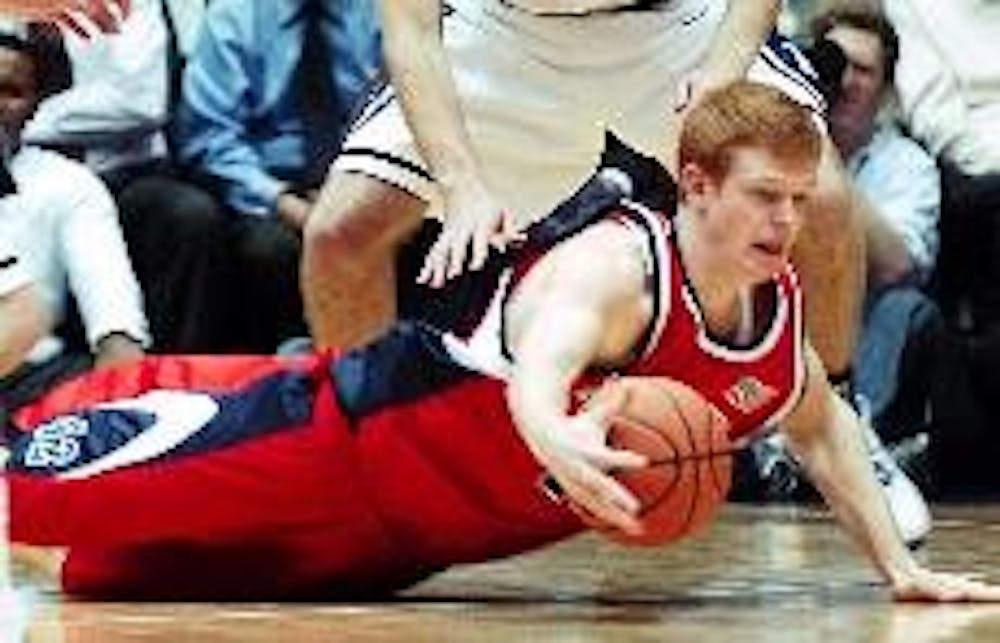
How smoothly will the transition from Fran Dunphy to Glen Miller transpire? Is this the year that the Quakers finally win an NCAA Tournament game?
These are two very difficult questions that will take the entire season to answer.
But behind those are five questions, the answers to which will determine the fate of the most promising Penn team in years and define the beginning of an era.
1. Who will take Eric Osmundson's and David Whitehurst's minutes?
Between them, the guards accounted for 55 minutes a game, and with Osmundson graduated and Whitehurst academically ineligible, Miller must look to youth.
Ibrahim Jaaber averaged nearly 37 minutes per game last year, so he won't be able to contribute much to the missing 55. Beyond that, the experienced options are limited.
Brian Grandieri should see his time increase with a more defined role, but he averaged more than 20 last year, so there are still plenty to go around, even when Mike Kach comes back from injury. Sophomore Kevin Egee played a few minutes as last season wound down, and Aron Cohen could get some time at the point position.
But the biggest contribution could come from one of their classmates.
2. How will Tommy McMahon recover from a rough season?
As a freshman last season, the swingman played a good deal of minutes, but he saw that decrease with his ineffectiveness and a back problem that eventually shelved him for the final month of the season.
McMahon, heralded as a tremendous three-point shooter, hit just 10 of 47 from behind the arc and shot 30 percent from the field. He also turned the ball over 15 times, compared to four assists.
Miller expressed optimism that the sophomore has shaken off the injury and can do the same with the shooting troubles.
A lot of the Quakers' success in 2006-07 will depend on outside shooting, and McMahon may have to be a large part of that.
3. Can the zone offense find a rhythm?
A lot can be learned from looking at the Ivy League schedule during Dunphy's final season. Over the first trip through the schedule, Penn was 7-0 with an average margin of victory of 23.1 points. During the second cycle through, the Quakers went 5-2, with an average margin of five, costing them a couple of seeds in the Tournament.
A major reason: Teams figured out how to defend the Quakers.
During the last seven games, Ivy opponents used the zone defense to get the Penn offense out of sorts, and the Quakers had little answer.
Miller addressed this in preseason practices, emphasizing outside shooting - the most effective way to beat the zone defense. The shots will be coming from all sources, from the guards to Mark Zoller and Steve Danley, who showed some range last year.
Last year, the Quakers shot only 32 percent from beyond the arc, while their opponents hit at a 37-percent clip.
4. Will the Quakers pay for Dunphy's misuse of the bench?
Another reason for the difference between first half and second may have been Dunphy's reliance on the starting team to get the Quakers across the finish line.
Behind Danley and the injury-prone Zoller, Brennan Votel played 58 total minutes and Cameron Lewis 18.
And in terms of true frontcourt players, that's all the experience returning. So if Zoller or Danley gets hurt or sees foul trouble, the responsibility will fall to those unproven forwards or freshmen Justin Reilly and Andreas Schreiber.
5. Can Penn win the close games?
It was all too commonplace at the end of the Dunphy era. When the game came down to one big shot or a key play, the Quakers more often than not came out on the losing side.
Last season, nine of Penn's 29 games were decided by seven points or fewer. The Quakers went 5-5, but the five wins - Siena, Hawaii, Harvard, Yale and Brown - were matters of surviving a comeback, not making plays at the end.
Turn a couple of those close losses into a couple of wins, especially against teams like Temple, Villanova and St. Joseph's, and it might turn a 15 seed into something much better.

