

Dawn came at 7:12 this morning, and the sun will shine for a little over 11 hours until dusk arrives at 6:20 this evening.
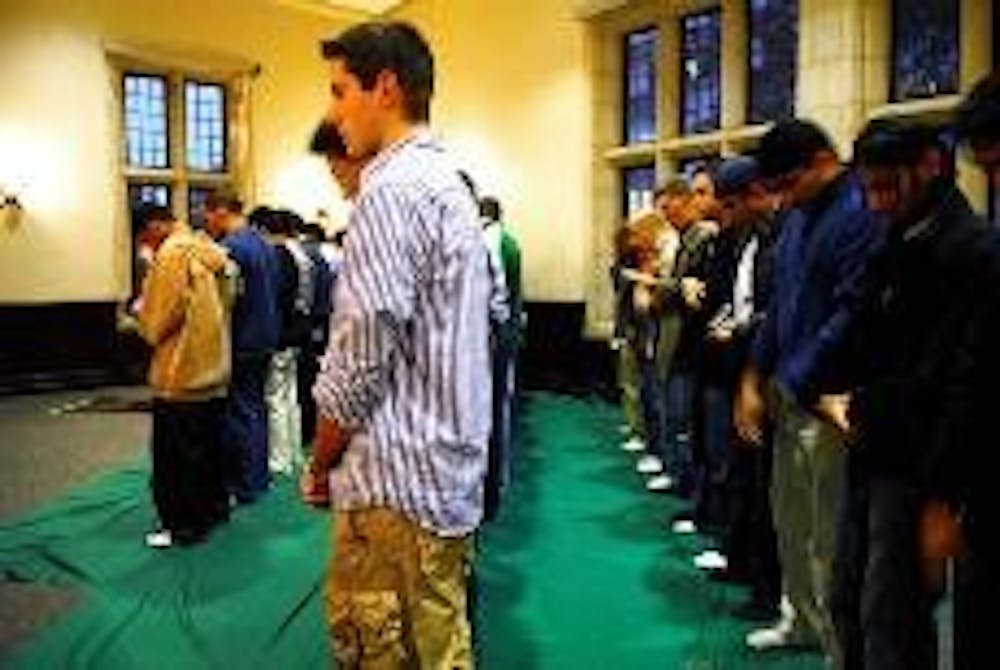
The precise number of daylight hours may have no bearing on the typical Penn student's sleep schedule or mealtimes. But for the University's Muslim student population during the holy month of Ramadan, the sun governs when to eat, when to sleep and when to pray.
Muslim students observing the holiday have been fasting from sunup to sundown since Ramadan - a time for self-control and restraint - began on Sept. 23. This weekend, however, their non-Muslim counterparts were given a chance to experience the rite of fasting.
Penn's Muslim Student Association hosted a Ramadan fast-a-thon this past Saturday to benefit the Greater Philadelphia Coalition Against Hunger. About 150 non-Muslim students participated in the fasting, which raised over $500 through donations and sponsorships from local businesses, according to MSA leaders.
They broke their fast with a catered banquet Saturday night in Houston Hall's Hall of Flags, which some 200 people attended.
College senior and MSA member Azam Qureshi said fasting during Ramadan forces people to reflect on those who may be less certain where their next meal is coming from. Because of this spirit, it made sense to donate proceeds to a food pantry, he added.
"By not eating for a day, you guys were serving someone else food," Qureshi told participants at the banquet.
Ramadan fast-a-thons have been taking place on campuses across the nation for the past five years. Since the University of Tennessee held the first fast-a-thon in 2001, the event has expanded to over 230 participating organizations.
Leaders say these events not only raise awareness for issues like world hunger but also promote more dialogue about Islam in a post-9/11 world.
During Ramadan, practicing Muslim students adapt their schedules so they can balance traditional college activities with religious rituals.
Qureshi, who lives in a house with several friends who are also Muslim, said he and his housemates often wake up as early as 5 a.m. to eat and pray together. After that, however, they go back to sleep, Qureshi said, adding that he believes the vast majority of American Muslims return to bed after their early-morning prayer.
"It's really not as hard as it sounds," Qureshi said.
For many participants, the fast-a-thon was a one-day opportunity for non-Muslims to understand what Muslims go through every day during Ramadan.
"So many of my friends are fasting for Ramadan, and I wanted to experience what they're experiencing," said College junior Nitika Dabas as she enjoyed food for the first time all day at Saturday night's banquet.
Learning more about Islam has become such a driving force for some non-Muslims that they choose to fast all throughout Ramadan.
College senior Matt Mawhinney has studied Arabic at Penn, and on a trip to Morocco over the summer, he began dating a Muslim woman. In order to better understand her culture, Mawhinney said he decided to fast for all of Ramadan in addition to participating in the fast-a-thon.
Still, fasting was challenging for many participants.
Hunger made it hard to focus, for example, when Dabas tried to study for her MCAT, she said. And for College senior Soham Dave, not being able to drink water after a long singing practice was difficult.
In the end, though, they made it to sundown.
"Anything for a good cause," Dave said.

