

There just might be life on other planets, according to one astrobiologist.
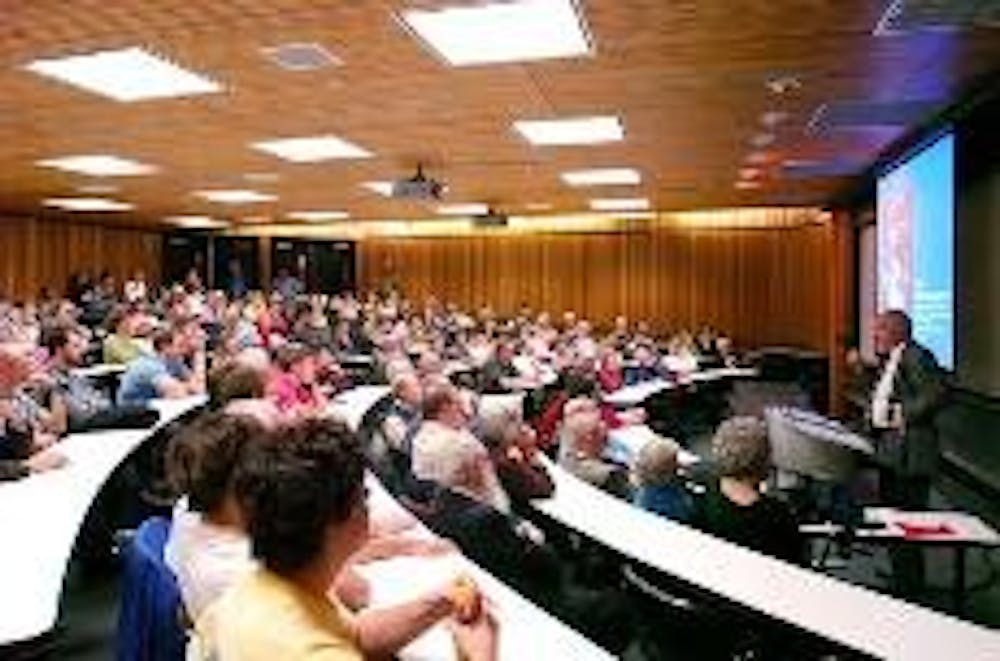
Nobel Prize winner Baruch Blumberg spoke about his field in front of a packed auditorium in Steinberg-Dietrich Hall.
Blumberg said that even if life only originated on one planet, it could have moved to others via meteorites.
Organisms that manage to burrow into rocks like meteorites are well protected and can survive the process of re-entry through a planet's atmosphere, he said.
His field, astrobiology, is a broad discipline that studies the origin, evolution and future of life on Earth and in the universe, Blumberg said. It investigates philosophical and religious questions such as the definition of life and death from a scientific point of view.
While scientists have discovered organic compounds that have come from space, Blumberg noted, they have not found actual organisms.
But he added that scientific research has shown that organisms can live in extremely challenging environments such as those that would be found on other planets.
"There are bacteria that can live in the cooling pools of nuclear reactors," he said.
Blumberg also referred to the report yesterday that there are potentially billions of planets in our galaxy.
And, while he would not say whether he believed extraterrestrial life exists, he said that life is possible wherever there is water.
"I think there is a sufficient possibility to keep looking," Blumberg said.
Blumberg said astrobiological research takes multiple generations to be completed.
Research vessels, for instance, take years to reach their destinations and to begin sending data.
"Most of the stuff I've worked on won't be completed until I'm dead," he said.
Blumberg spoke as the inaugural lecturer of the Penn Association of Senior and Emeritus Faculty's annual series.
He teaches medicine and anthropology at Penn and is known for having helped develop a vaccine for Hepatitis B, for which he won the Nobel.
Biochemistry and Biophysics graduate student Carlos Gay-Antaki said he found the lecture interesting.
"I think I was most interested in the philosophical questions they began the lecture with," Gay-Antaki said.

