

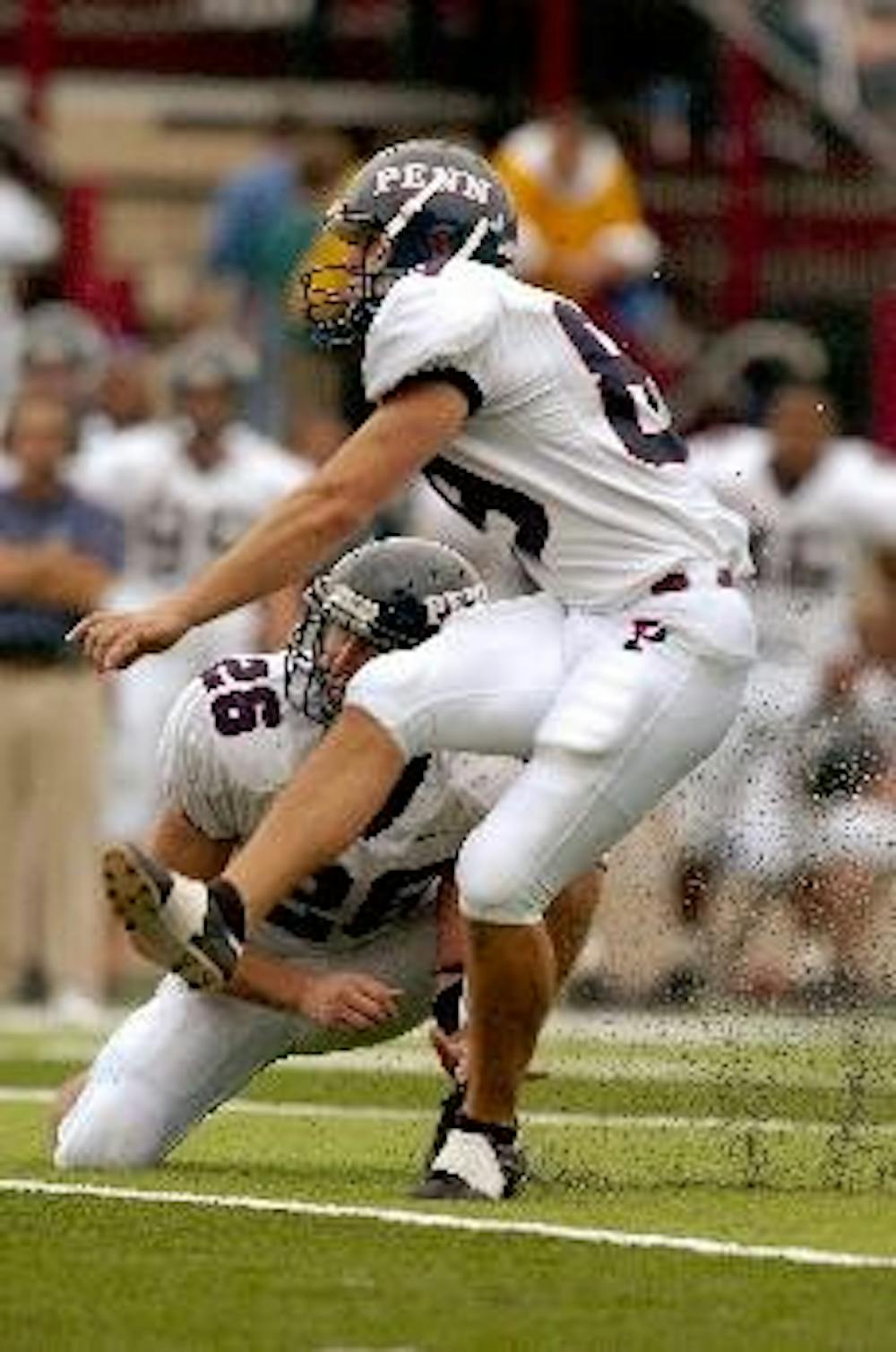
With 36 seconds remaining in the first half of last weekend's football game against Dartmouth, coach Al Bagnoli was presented with a decision. The Quakers had the ball at the Dartmouth 9-yard line on 4th-and-1. Should Penn go for the first down or try to kick a 26-yard field goal?
Bagnoli decided to call in his kicker - and he shanked it.
I am not so clairvoyant as to know whether the Quakers would have gotten the first down had they had gone for it, but I believe they should have tried.
The first issue is not the kicker, it is the difference between a field goal and a touchdown.
If Penn had gotten into the end zone, it would have been riding tremendous momentum into the second half. However, Bagnoli went conservative.
This tendency is not new for the coach. The Quakers have averaged just 14.2 fourth-down conversion attempts per season over the last five years. It is his philosophical outlook.
It might not be necessary for him to be so cautious, though. During that five-year period, the Quakers successfully converted 62 percent of the time.
Perhaps it is because for a large stretch of that five-year period, the Quakers blew out nearly every opponent they faced on the way to winning several Ivy League championships. They could forsake potential touchdowns for field goals because they knew they would score again. This is no longer the case.
The Quakers have had stunning success converting fourth-down opportunities. The Ivy League on a whole has done well over this season, converting 51 percent of the time.
Given such favorable numbers, Bagnoli should go for it on fourth down more often.
Despite that success, Bagnoli does not favor attempting a fourth-down conversion in a red-zone situation. When asked about his fourth-down philosophy, he said, "It would have to be that you are located in no man's land; by that I mean that you are out of field goal range, and you have a manageable fourth-down opportunity."
But even in these situations so far this year, Penn has passed on trying to continue the drive. Against Lafayette, the Quakers faced a fourth down between their opponent's 30 and 40 yard lines four times - two with seven to go and two with five to go, and they punted each time.
As for when fourth downs occur deeper in enemy territory, Bagnoli favors the automatic points. But for the Red and Blue those points have been anything but automatic lately.
Ever since Peter Veldman graduated in 2003, the Quakers have struggled to find a reliable kicker. Derek Zoch tries admirably, but he just doesn't get the job done. He is a career 14-for-25 and an unremarkable 7-for-15 in attempts over 30 yards.
It is difficult to fault Bagnoli for not recruiting and developing a better kicker when the rest of the league has only made 21 of 31 field goals. In fact, Brown, Dartmouth, Harvard, Princeton and Yale have combined to send just eight of 17 attempts through the uprights.
Ivy League kickers have converted 88 percent of point after touchdowns this year, but hitting at that rate on those supposedly automatic points is nothing to be happy about.
Yet given the dependable lack of dependability of Zoch, Bagnoli should put much more faith in his offense in short yardage situations.
Yes, if Zoch had made the field goal, the Quakers would have gone into halftime up a touchdown. And I can understand the desire to acquire certain points. But imagine if Penn had been up 14-3 at the half - Dartmouth would have had a big hill to climb.
This is a new Quakers era, and it is time for a new and bolder Quakers philosophy. Go for it!
Matt Meltzer is a senior political science major from Glen Rock, N.J. His e-mail address is meltzerm@sas.upenn.edu.

