

Football can be a very complicated game, but oftentimes it is very simple. In six of Penn's seven games this season, a very simple trend has prevailed - when the Quakers rush more than 25 times in the game, they win, and when they rush less than that, they lose.
Clearly, this fact is inflated in blowouts when the leading team runs more often to protect a lead and not turn the ball over. But because Penn only retained a large lead in one game, this caveat doesn't apply.
One exception to the trend is the game against Yale on Oct. 21, where Penn ran 36 times for 133 yards, but was held to only 14 points, because of two interceptions, two missed field goals and a missed fourth-down attempt.
But it was out in full force in Penn's 30-27 loss to Brown last Saturday. The Quakers ran only 24 times, for 68 yards, while they passed 36 times.
Penn coach Al Bagnoli explained that Brown was stacking the box to prevent the run and had been giving up big numbers in the passing game, so Penn's plan was to pass the ball.
Later on, Bagnoli hoped to pass successfully enough in order to force the Bears away from their run-stopping defense and be able to run the ball.
"It's unfortunate, but that's the way we had to attack it," he said.
But in the fourth quarter and overtime, when Penn did not score a single point, it ran the ball only five times on 19 plays.
The loss to Brown also marked the second time this year that Penn ran on less than 45 percent of its first downs, with the other a loss to Villanova.
On the season, the Quakers have run on 56.2 percent of first downs. But that breaks down to 61.7 percent in their four wins and only 48.8 percent in their three losses.
However, Penn's rushing average has been relatively consistent regardless of the result of the game. In the four wins, the Quakers have run for 4.4 yards per carry, and, in their three losses, 4.1.
This statistic seems to indicate that Penn has just not rushed the ball in certain games. The Quakers' average of 4.3 yards per carry is third in the Ivy League, behind Yale and Harvard, but their 30.4 rushes per game is seventh, ahead of only Columbia.
Sophomore quarterback Robert Irvin and junior Bryan Walker, who has played sparingly, have not seen immense success throwing the ball, which makes an even stronger case for Penn needing to run more often.
The Quakers are fourth in the league in pass yards, despite a league-best 19.4 completions per game and second-best 10 touchdowns.
But Irvin leads the league with 10 interceptions, which have often come at very inopportune times, like his pick right after Brown's missed fourth down early in the fourth quarter.
Senior running back Joe Sandberg is still third in the league in rushing yards and is second among league starters in yards per carry, at 5.0. Yet he has 26 fewer carries than No. 2 Clifton Dawson of Harvard and 62 fewer than leading rusher Mike McLeod of Yale.
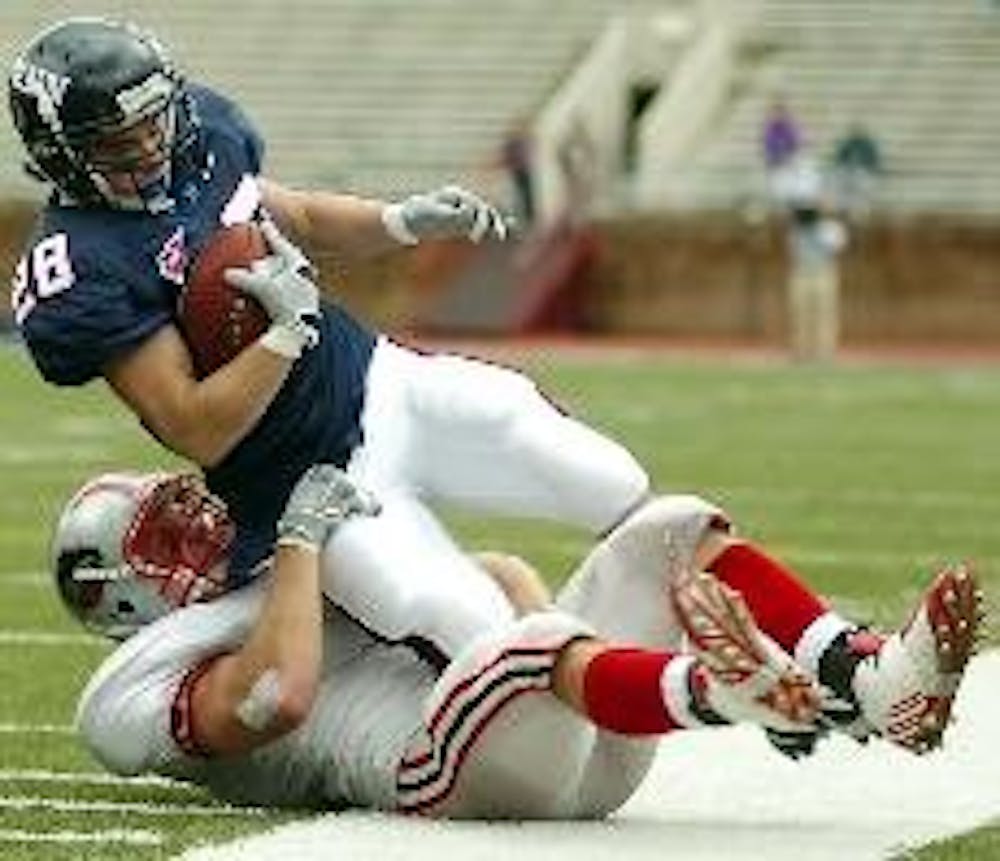
As Penn tries to right its ship, the answer may come, according to the statistics, with calling Sandberg's number 28 more often.

