

EASTON, Pa. - Watching the game in real time, the question was obvious: Looking at the box score, it became even more pressing.
Quarterback Brad Maurer, tailback Jonathan Hurt and the rest of No. 22 Lafayette's vaunted offense were able to tally six more first downs, 48 more total yards and three fewer punts than their opponents, the unranked Quakers, on Saturday.
So how was it that the Leopards were unable to make all that firepower show up on the scoreboard?
Quite simply, the Quakers didn't allow big plays deep in their own territory. The untested secondary may have given up 286 yards to Lafayette's vertical game, but those weaknesses were masked when the Quakers were simply charged with bringing down the man with the football.
"They did a nice job of clamping down," said Maurer, who has seen his fair share of stout defenses in his 26 career starts. "That's something that's been characteristic of our defense the last couple of years. . You can see that they had a good mentality in the red zone."
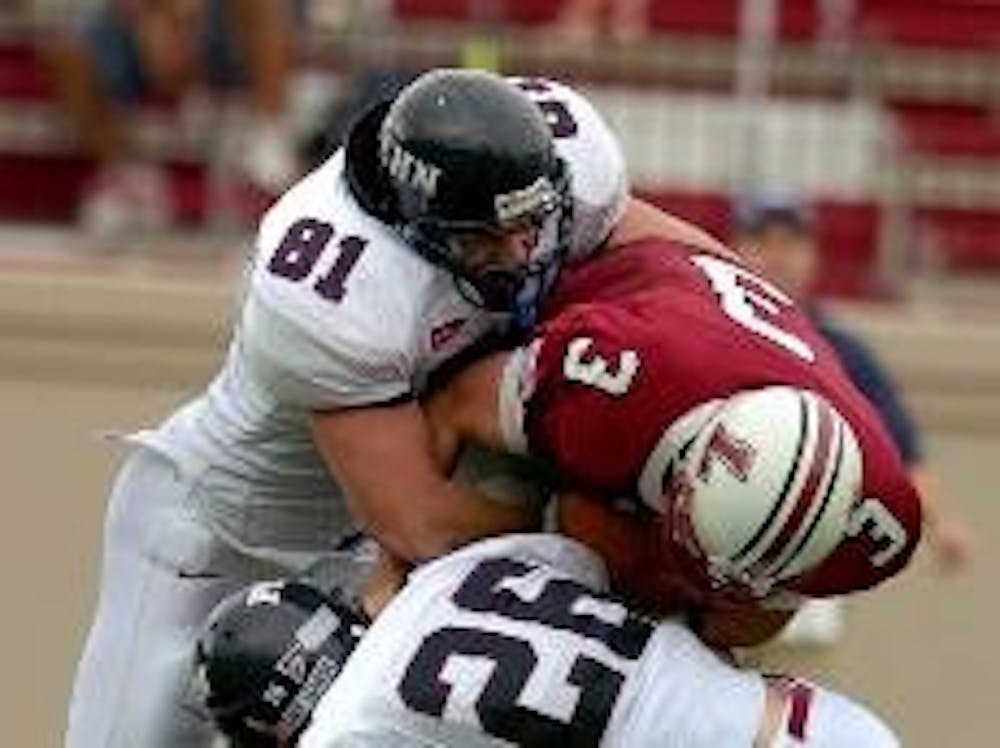
That fact seemed to surprise Maurer, who marched down the field virtually unopposed several times, only to find his efforts stymied at the goal line. On the Leopards' first big drive of the game, the Quakers seemed overmatched. Hurt got around the corner in his own territory for 26 yards with no blockers, Penn defensive back Jordan Manning was burned after another catch and a penalty put the ball on the Penn 9-yard line.
But the next three running plays actually produced a loss of yardage, as Maurer and Hurt were repeatedly stuffed near the line of scrimmage, and the Leopards were forced to settle for a field goal as the second quarter opened.
The performance was oddly reminiscent of the unit's fortunes last year, where defense in the red zone went from a question mark to a strength to a liability as the season dragged on.
But from that first drive onward, it became clear that the defense had the tools to make an impact.
The battle ended in the Quakers' favor again in the third quarter -- already in Penn territory, Hurt went through, over, and then around the defense with nothing but six points in front of him, but he carelessly stepped out of bounds just five yards short. The Leopards were stuffed on the next three plays, two of them handoffs with nowhere to go and the next a short screen pass broken up by senior Kory Gedin. (To top it all off, Lafayette had nothing to show for the drive after its field-goal attempt was blocked).
"As the ball incrementally moves down closer and closer, it becomes harder and harder to score for both sides," Penn coach Al Bagnoli said. "Nobody backs up, there's no vertical game, there [are] very few seams."
Bagnoli and defensive coordinator Ray Priore had singled out communication in the defense and pass coverage as concerns heading into the game. And sure enough, the secondary's youth produced more than a few problems. The dynamics of the game, though, meant that the key battles in the war between Penn's defense and Lafayette's offense would be fought close to the goal line- - where communication and strategy took a back seat to physicality and aggression.
If the last game is any indication, that matchup could prove favorable to this new -- perhaps even reborn - Quakers football team.

