

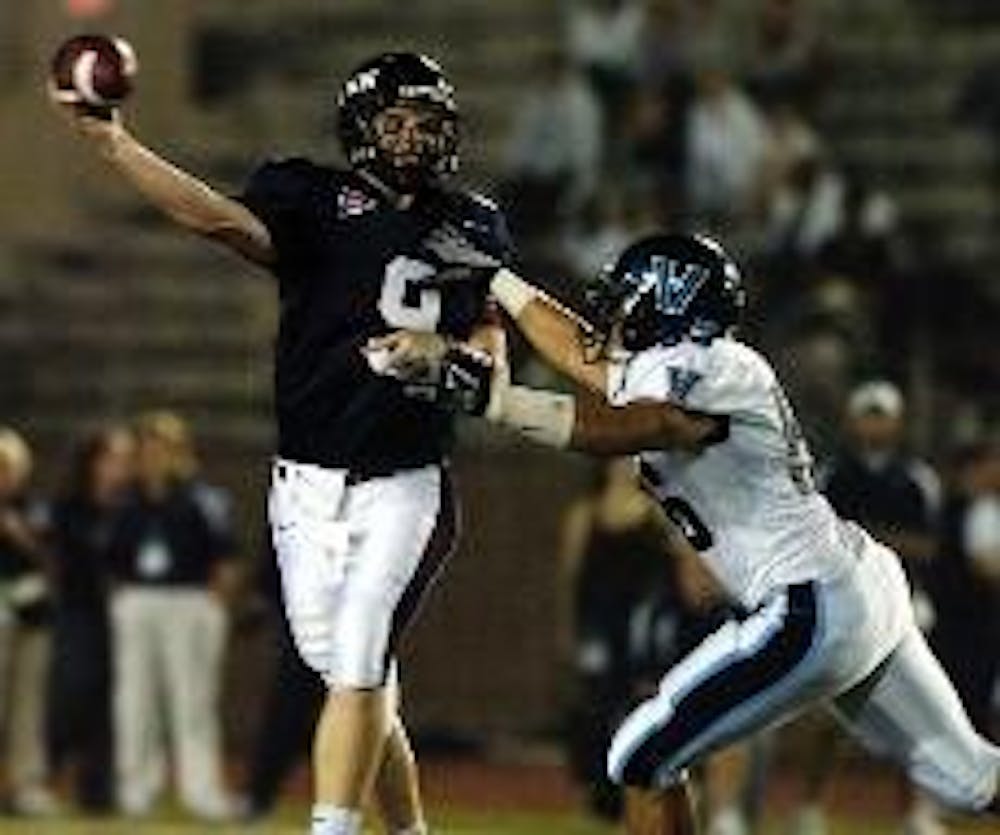
This wasn't supposed to happen to the Penn offense - not after the test it passed in its opener against Lafayette. It looked as if quarterback Robert Irvin had already proven himself capable of getting the ball to his receivers, and Joe Sandberg had shown that he is the type of running back that can carry an offense.
But Villanova's defense, which had given up an average of over 32 points per game before Saturday, stymied Penn and put these notions into question.
After rushing for 166 yards against the Leopards, Sandberg struggled to sustain any consistency against the Wildcats in Week 2.
While the senior did reel off a game-tying 74-yard scamper in the second half, he managed just 1.4 yards per carry aside from that run, including just 10 yards in the second half.
And when the running game suffers, the entire offense does as well.
"We couldn't establish any consistency in our running game," Penn coach Al Bagnoli said. "It puts a lot of pressure on the kids up front, it puts a lot of pressure on some young receivers. And those are the two areas that we thought we would have enough experience."
Irvin, who typically doesn't stray far from the pocket, was affected by this pressure. The sophomore looked the part of a first-year starter adjusting to a new offense, missing his receivers on three straight plays and ultimately completing just 11 of 24 passes, including two interceptions.
He was unable to find an open man and was forced to hold on to the ball longer than he wanted.
If it wasn't obvious that Irvin was struggling from watching him force passes left and right, it was clear when Bagnoli chose Sandberg, not usually in the spotlight as a passer, to be his go-to guy to get the ball into the end zone. Sandberg's 26-yard lob to fellow running back Kelms Amoo-Achampong was the longest pass of the day, and the only score through the air for the Quakers.
In the second quarter, Bagnoli mixed things up by replacing Irvin with more fleet-footed backup Bryan Walker for a series, and would eventually be forced to put Walker in for good after Irvin twisted his ankle in the fourth.
Bagnoli's faith in his young gun might still be intact, but he was forced to acknowledge that Irvin didn't exactly look like a seasoned veteran on Saturday.
"They put way too much pressure on a sophomore quarterback," Bagnoli said. "We got him into way too many 3rd-and-longs, and I think at that point the inexperience of a sophomore quarterback starting his second game shows."
Irvin's replacement didn't fare much better. Walker's 5-for-16 passing-clip and sloppy intentional grounding penalty were reminiscent of his streaky, if brief, appearances last year. But there was one silver lining - he made plays with his legs. Walker rushed for 20 yards on just three attempts. He also moved the Quakers downfield in the final two and a half minutes after a scoreless second half, including a key 4th-and-22 completion to Braden Lepisto.
But this boost may have come as a result of the circumstances rather than by any calculation - the fast-paced hurry-up offense that Penn had to resort to may cater to Walker's strengths.
"No-huddle is something we practice a lot, it gives you an up-tempo attack," Bagnoli said. "We didn't really have much choice at the end, we only had 50 seconds left."
When Penn plays Dartmouth next week, the Quakers hope their first red zone appearance will come with a bit more time on the clock.

